Left or Right? Either Will Do

Have you ever had to decide between two options that looked equally good (or equally bad)? It’s like being in a Choose Your Own Adventure book, where the page number you pick can lead to either the villain’s defeat or your own death. (And it’s always death by quicksand, or alligators, or something similarly dreadful.)

Fork in the road

But both of the paths looked so inviting…
Image Credit: P L Chadwick. Source: Wikimedia Commons. CC BY-SA 2.0

It can be just as hard to write a sentence that describes two equal things or ideas. Luckily, there are some handy connecting words that can help you pull everything together. These words are called correlative conjunctions.

Correlative conjunctions always come in pairs, so they are easy to spot (unlike those sneaky alligators). Examples of these conjunctions are

both….and

not only…but also

whether…or

either…or

neither…nor

The tricky part is figuring out where to put these words in your sentence.

Since correlative conjunctions connect two equal items, both of these items should have a parallel grammatical structure. This is easy to miss when you are in the middle of writing. Let’s create our own adventure to see how correlative conjunctions can help you to balance your sentences.

Choose Your Own Adventure: Magic or Mayhem

Both Jadeira and Karlon despised the evil Queen.

[Our adventurers, Jadeira and Karlon, are both proper nouns. So the two of them are grammatically parallel.]

The Queen was not only a vile sorceress, but also a grasping tyrant.

[Both a vile sorceress and a grasping tyrant have the same structure—article (a) / adjective (vile, grasping) / noun (sorceress, tyrant). So the two items are parallel. But look at what would happen if we wrote this sentence differently…]

The Queen not only was a vile sorceress, but also a grasping tyrant. ✕

[In this case, the first item starts with a verb (was) and the second item starts with an article (a). So we know we’re in trouble, and we haven’t even seen any alligators yet!]

The two companions debated whether to take the left path towards the town (and obtain reinforcements) or take the right path towards the Queen’s lair (and confront the Queen immediately). 

[This is a long sentence, and could definitely use some editing. But it is grammatically parallel. You can see that whether works a bit differently from the other correlative conjunctions. The parallel items don’t always follow directly after the word whether. In this case, the parallel items are following the infinitive to.]

As a result of their choice, they would either achieve a stunning victory or suffer a gruesome and bitter defeat.

[Grammatical parallelism does not mean that everything has to be identical. Both of the items above start with a verb (achieve, suffer) and are followed by a noun phrase. As long as the pattern of each item is similar, you are on the right path.]

Neither Jadeira nor Karlon could decide on the best course of action.

[In sentences like these, we use neither/nor rather than either/or. This is because we are replacing the negative word not: “Jadeira and Karlon could not decide.”]

Jadeira looked at Karlon. “You still have that silver coin?”

Karlon pulled the coin from his pocket, preparing to flip it.

Both adventurers were so focused on the coin that they did not see the giant alligators lurking in the water…

If you agree that Jadeira and Karlon should be eaten by the giant alligators, turn to page 32.

If you would rather get eaten by alligators than suffer through another grammar lesson, then you are on the wrong page. Go to another blog, and enjoy!

If you have thoughts to share about this grammar lesson, go to the bottom of this page. Make a comment.

THE END

(P.S. This post is dedicated to Nicole de Courval, who suggested that I write about either and neither. If you have a topic idea for a post, please contact me. I love writing about thorny grammar challenges!)

Me, Myself, or I—Whodunnit?

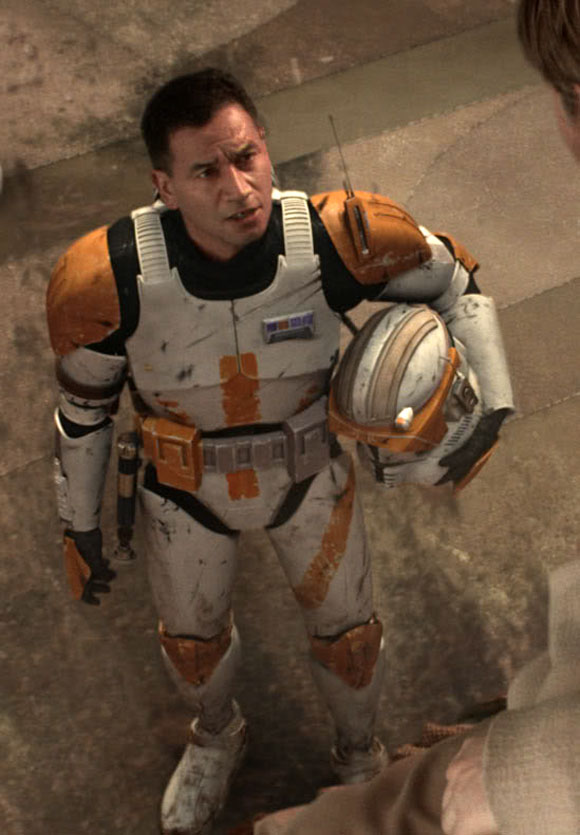
I’m dealing with a pronoun identity crisis. It’s like trying to pick a clone from Star Wars out of a lineup. Me, Myself, and I are all possible suspects. Which one should I use in my sentence? With the help of Anne Stilman (and with apologies to Jango Fett), I’m going to sort out these annoying pronoun clones once and for all.

Suspect Number One: I, the Arrogant Subject

Jango Fett from Star Wars

I am in control of my destiny!

 I is a “take charge” kind of pronoun. I demands pride of place as the subject of a sentence (the person committing the action).

I will lead my troops to victory! ✓

I continues to demand this right even when there are other subjects in the sentence.

Yoda and I will never be good friends. ✓

I hates it when someone writes Yoda and Me. ✕   This is simply disrespectful.

I also barges in when there are comparisons between two subjects. I shows up even when there is no verb following it.

Mace Windu thinks he is better than I. ✓

In the sentence above, the verb is implied. The full sentence is below.

Mace Windu thinks he is better than I am. ✓  (What a fool!) ✕

I wants you to know that missing words don’t excuse you from getting this right. Don’t screw it up by saying Mace thinks he is better than Me. ✕

I is also arrogant enough to crowd in directly after a verb, when the verb is a form of to be (is, am, was, were).

It is I, the great clone warrior! ✓

In this case, I is following a linking verb (is). A linking verb links the subject to the item that follows it. It (the subject) = I (the subject).

I wants us to understand that I is clearly > Me, so It is Me is ridiculous. (Although this usage is increasingly accepted—for another view, check out Grammar Girl’s take on “It is I.”)

Bottom line, I is an attention hog and a horrible dinner companion. Enough said.

Suspect Number Two: Me, the Objectified Victim

Jango Fett from Star Wars - 2

Why is everyone always bothering me?

Everyone is always out to get Me. Instead of being a subject, this pronoun is treated as an object. Verbs are constantly acting against Me.

They are all plotting to dispose of Me. ✓

Since I is a hog, it likes to kick Me out of its rightful place when there are multiple objects in a sentence.

The Jedi are pestering Boba and I. ✕

This is completely wrong, and makes Me suffer. Here’s the correct version.

The Jedi are pestering Boba and Me. ✓

On a bright note, there is one sentence where Me is not the underdog.

Woe is Me. ✓

At first glance, it looks like I should be taking over this sentence. (Remember when I followed the linking verb is in It is I?) Not so fast. This is another sentence with some implied words.

Woe is delivered unto Me. ✓

Me continues to be an object here, as the receiver of a delivery. So Me wins this round (if you can call it winning).

How appropriate that we are talking about woe around such a moping and hard-done-by pronoun. Let’s move on from Me—the party pooper.

Suspect Number Three: Myself, the Perpetual Sidekick

Jango Fett from Star Wars - 3

I really need to stand up for myself.

Myself really needs a mind of its own. Instead, it follows I around everywhere, feeding I‘s superiority. This is why Myself is known as a reflexive pronoun. It is a reflection of I.

I can’t fight this war all by Myself! ✓

(Guess it’s time to make some more clones then.)

Sometimes Myself tries to rise in importance by acting as an intensive pronoun. Myself intensifies what I is saying.

I Myself believe that war is the only true answer. ✓

This is a correct sentence, but Myself is still following I around, so I’m not sure how successful its ploy for greatness is.

In a last bid for glory, you can find Myself trying to act like a subject or an object.

Dooku and Myself are clearly both subjects. ✕

The Jedi insulted Myself and my other clone brother objects. ✕

The pronoun should be I in the first sentence, and Me in the second one. Myself is out of luck. It continues to be a tagalong pronoun. No wonder it got dragged into a lineup with the other pronoun troublemakers!

I think my pronoun identity crisis is over. The verdict? All of them are still annoying. But at least I know when to use them in my sentences. Now if only they can stay out of trouble!

(Have you experienced pain with pronouns? Are there any particular grammar challenges you would like to see me tackle here? Please share your thoughts below.)

If wishes had genies…

Verbs have moods, just like genies do. And we all know you need to pay attention to someone’s mood if you want to get your wish. (“Can I have a cookie, Mom? Pleeease?” Oh, no, it’s not working! Time for the cute face. “I love you.”)

Disney’s Aladdin shows us all about moods and how we can stay on the good side of verbs. The film’s characters use the three verb moods: indicative, imperative, and subjunctive. Let’s see how each mood can affect your chances of getting your wish.

Indicative Mood

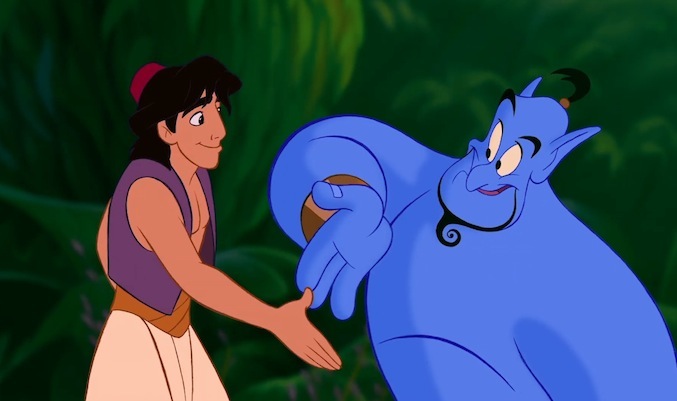
We use the indicative mood most of the time. This verb mood is good for stating facts, making requests, or asking questions. Aladdin uses this mood when he says, “Genie, I wish for you to make me a prince.” The verb in this sentence is wish. This is a simple request, and Genie is happy to lend a hand:

Disney's Aladdin and Genie shaking hands

You’ve got a deal!

Imperative Mood

We use the imperative mood for commands. Our story’s villain, Jafar, is fond of using the imperative mood. After he steals the lamp, he commands: “Genie, grant me my first wish.” Here, the verb is grant. Jafar could have said, “I would like you to grant me my first wish,” which would have been more polite (and indicative). But no. And guess what happens when you use the imperative mood on a genie?

Genie cheering for Jafar in Aladdin

Can you tell I’m motivated?

Subjunctive Mood

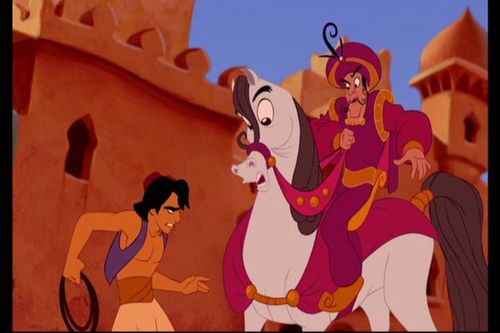
This final verb mood is the trickiest. We use the subjunctive mood for unlikely possibilities, things that are not true, and (you guessed it) wishes. You often find the subjunctive mood hanging around with the word if. Aladdin uses the subjunctive when he protects children from being whipped by a rude prince. He says, “Hey, if I were as rich as you, I could afford some manners!”

We can tell this is the subjunctive mood because Aladdin says I were. This can sound strange to our ears, because normally people say I was. With the subjunctive, however, the verb form were is always used (if I were, if you were, if he were, if she were…).

So why is this verb mood important? It tells us that Aladdin thinks he will never be rich. After all, he doesn’t have a genie to help him with that…yet.

Disney's Aladdin on manners of the rich

If only I had a genie…

Once Aladdin finds Genie, he never uses the subjunctive mood again. Why? Because he knows that his wishes will come true. They are no longer unlikely to happen. So, unlike the rest of us, he doesn’t need to think about when to use the subjunctive mood.

After talking about this, now I really want a genie. I’m sure it would improve my mood. Imagine the possibilities…