Rogue Words from A to Z: On To An Occasion

The Road goes ever on and on
Down from the door where it began.
Now far ahead the Road has gone,
And I must follow, if I can,
Pursuing it with weary feet,
Until it joins some larger way,
Where many paths and errands meet.
And whither then? I cannot say.

– J.R.R. Tolkien, The Fellowship of the Ring

A to Z Letter OWhen I was thinking about how to explain the difference between on to and onto, this poem about travelling came to mind.

On to is about the journey.

Onto is about the destination.

Imagine that you have decided to take a journey on foot to a distant land. To get to your destination, you must reach the crossroads.

So you walk on to the crossroads.

This sentence is describing your journey to the crossroads. It could take you all day to get there, or it could take you five minutes. (Let’s go for all night and into the morning — it sounds suitably epic.)

Finally, you reach your destination and walk onto the crossroads.

At this point you are walking on top of the crossroads. You have arrived at a certain point.

You take the King’s Road, which winds through an ancient forest situated on the side of a steep hill.

Crooked Forest, Nowe Czarnowo

A forest like this one…


Unfortunately, you are going in the uphill direction, so you need to start climbing instead of walking. Once you are partway up, you spot a giant tree that has fallen across the road at the very top of the hill.

You groan in irritation, but you continue to climb on to the tree.

This describes your journey to reach the tree.

Your legs are killing you when you finally get to the top of the hill. After a brief pause, you begin to climb onto the tree.

Thankfully it has lots of hand- and footholds, and you make it to the top without too much trouble. You have made it onto the tree. You have arrived at your destination.

As you sit on top of your giant tree-bench, you reward yourself with a second breakfast. As you munch away, you hear occasional birdsong floating down from the birds that have landed onto the branches of the tall trees. As you finish the last crumbs and decide to move on to the river, you suddenly become aware of the silence. When did the birds stop singing?

Uh oh. You had forgotten that monsters occasionally travel this way…

Bonus Word: Occasionally

Before ending our story, let’s look at the tricky word occasionally, which is a challenging word to spell. How can you remember it?

If you separate the base word and its suffix, you get occasion + ally.

On the rare occasion when you encounter a monster, it is good to have an ally with you. Luckily, you remembered to bring your magic ring on your forest journey, and you call your wolf spirit animal to your side.

So now let’s look at the word occasion. It’s made up of two parts as well: occa + sion.  The -sion suffix is recognizable — it’s also used in tension, which you felt before you remembered your magic ring.

This leaves us with occa.

Which is perfect, because with your wolf at your side, you are going to be ok-kay. After all, wolves like seconds breakfasts, too. 😉

***

Have you ever been on a long journey?

Image of Crooked Forest, Nowe Czarnowo from Wikimedia Commons

(Shortly after writing this post, I saw this article about someone who doesn’t think onto is a word, and just had to share it here.)

This post is dedicated to everwalker and Rachel Small. Thanks for reading!

Stay tuned for tomorrow’s post, where I will pummel the pernicious letter P…


© Sue Archer at Doorway Between Worlds, 2015
Rogue Words from A to Z: Nauseating Nightmare

A to Z Letter NToday I’m going to talk about that nasty little word nauseous and its cousin nauseate.

Traditionalists will tell you that nauseous should only refer to something that induces nausea.

Trask was leading his comrades in a nighttime raid against the enemy village. Suddenly he stopped in his tracks. What was that nauseous smell?

When you encounter something nauseous, you feel nauseated.

Trask held up a cautionary hand to his followers while he tried to identify the smell. It was difficult to make out, because all he could think about was how it made him feel nauseated.

Striped Skunk

Could it be these guys? No, guess again!


Today’s English speakers often use nauseous to describe the state of feeling nausea: “I feel nauseous” rather than “I feel nauseated.”

Skrim was right behind Trask. He started to gag, although he was trying valiantly to suppress it. “I feel nauseous,” he mumbled.

Many people tell you that this usage of nauseous is wrong. But even Garner’s Modern American Usage notes that this is a Stage 4 usage, which means that it is virtually universal but “is opposed on cogent grounds by a few linguistic stalwarts (die-hard snoots).” And the Canadian Oxford Dictionary goes so far as to say, “Objections to the use of nauseous in this sense on the grounds that nauseated should be used instead are ill-founded. This is in fact by far the most common sense of nauseous.”

Trask hissed at Skrim through his teeth, “You’ll never get to be a leader if you don’t use your words correctly.”

“Sorry,” Skrim muttered. Trask was tough on everything, including language.

Trask barely heard Skrim’s reply. He felt overpowered by the nauseating stench. Finally he identified it as the nauseatingly daisy-fresh smell of recently washed humans. The village had clearly anticipated their arrival, and they had all taken baths!

“Gaaah!” he cried in frustration. “Trolls, retreat!”

The grimy, stinky horde shuffled off to find better pickings elsewhere.

***

What’s the most nauseous smell you’ve encountered?

Image of skunks by Tom Friedel from Wikimedia Commons

This post is dedicated to Loni Townsend. Thanks for reading!

Stay tuned for tomorrow’s post, where I will overwhelm the objectionable letter O…


© Sue Archer and Doorway Between Worlds, 2015

Rogue Words from A to Z: The Merits of Morale

A to Z Letter MMan down! In today’s rogue words story, I will help you to master two pairs of easily mixed-up words: morale / moral and meretricious / meritorious.

Morale vs. Moral

Although these two words are spelled almost the same way, their meanings are very different.

Morale (pronounced moh-RAL) describes the amount of confidence or enthusiasm an individual or group has at a particular moment in time. This word often comes up in military settings to describe the feelings of the troops.

Marissa was obviously feeling maudlin as she recounted the tale of their team’s struggle to make their way through the maze of alien streets.

“There we were, with Master Sergeant Melanie in the lead, surrounded on all sides by those alien maggots. We knew it would be a desperate fight, and that we might not make it out alive. But we had confidence in Sarge.

“Our morale was high, because we felt that she would get us through it.”

Moral (pronounced MOH-rul) describes the goodness or badness of human behaviour, and the distinction between right and wrong. This is where we get the saying, “the moral of the story.”

“But then that good-for-nothing Magnus decided that it was his turn to be leader, and he shot Sarge in the back. I never thought of him as a moral person, but to do that right in the middle of combat? We were all shocked.”

Meretricious vs. Meritorious

These words are mouthfuls, aren’t they?

Meretricious describes something that is showily attractive, but valueless. Interesting fact: It is derived from the Latin word for prostitute (meretrix).

“Magnus was one of those types who could afford all the best armor and the rare and powerful guns. He sure looked the part of a leader. But he was meretricious. No substance to him at all.”

Meritorious describes a person or act that has merit and deserves praise or awards.

“Sarge deserved a medal for everything she did for us. Her actions were meritorious. But now she was dead. And we knew we were all doomed.”

Mark leaned forward from his perch on the basement couch. His mouth full of potato chips, he asked, “So what did you guys do?”

“Oh, we killed the game,” said Marissa. “And we kicked Marcus off the server. There was no way we were playing with that loser again. Luckily it wasn’t that far back to the last save point, so we didn’t lose a lot of progress. And then we kicked alien butt! You should have seen us!”

Bonus Word: Maudlin

The word maudlin has a fascinating history. It means being foolishly sentimental or self-pitying, and is often associated with crying drunkards. It comes from the Old French Madeleine from the Latin Magdalena, and refers to pictures of Mary Magdalen weeping.

***

Have you read or used the word meretricious? I have yet to use it in my own writing. (Other than in this post, of course. There’s a first time for everything!)

Definitions are from the Canadian Oxford Dictionary.

This post is dedicated to Shelley Sackier and Shawn. Thanks for reading!

Stay tuned for tomorrow’s post, where I will nab that nuisance of a letter N…


© Sue Archer and Doorway Between Worlds, 2015

Rogue Words from A to Z: Led to Lie Down Loosely

A to Z Letter LIt seems there are many rogue words beginning with the letter L that lull us into danger.

I’ve had requests from my readers to talk about the differences between lie/lay, lead/led, AND lose/loose. I didn’t want to leave anyone out. So today I’m going to be ambitious and write a bedtime story about all three topics, which hopefully won’t put you to sleep!

Lie vs. Lay

Once upon a time, there was a young boy named Lee who hated bedtime. It felt like every time he went to sleep he had nightmares.

He didn’t want to lay down his bedtime book on his bedside table.

He didn’t want to lie down in his bed.

He thought the rhyme “Now I lay me down to sleep…” was scary.

The difference between lie and lay is that lie is an intransitive verb while lay is a transitive verb.

An intransitive verb (like lie) is a type of verb that does not act on the direct object of a sentence. When you “lie down” you are not doing something to another object, you are simply lying down somewhere.

A transitive verb (like lay) is a type of verb that acts on a direct object. When you lay down a book, you are doing something to the book (putting it down). This is why you use lay and not lie.

Knowing this difference, you would think that “Now I lay me down to sleep” is incorrect, but it’s not. The object of lay in this case is me. You are saying “lay me down” (with me as the object) instead of “lie down,” which does not have an object. Both of these constructions are correct.

As if this weren’t challenging enough, the past tense of the verb lie is lay. (The past tense of lay is laid.) Ouch! You can see why this verb causes so many problems.  Here’s how this verb works in the past tense.

Lee laid down his bedtime book.

Lee lay down in his bed.

Lee tried not to think about bedtime rhymes, and closed his eyes tightly in fierce concentration. His fingers were clenched around the bedsheet.

Lead vs. Led

With his eyes squinched shut, Lee thought about what could help him sleep. How could he avoid the nightmares?

sandman in rise of the guardians

Image from Rise of the Guardians by DreamWorks SKG

In the darkness behind his eyelids, a fuzzy warm glowing dot appeared. It grew and grew, until all at once Lee could see that the warm light was shining from the Sandman.

The Sandman couldn’t speak, but he beckoned Lee forward. Lee knew that the Sandman was going to lead him to a happy dream with no nightmares in it. Lee started to go towards the Sandman. The Sandman turned and led him down a shiny pathway covered in jewel-bright flowers.

The past tense of the verb lead is led. People often use lead for both the present and the past tense, probably because the verb read is spelled as read in both of these tenses. But for lead, you need to use led when speaking in the past tense.

Lose vs. Loose

As Lee began to lose consciousness and slide into sleep, his clenched hands loosened and relaxed. He knew he would never lose his way and wander into a nightmare ever again.

To remember when to spell lose vs. loose, think about how you need to loosen up and lose your fears.

Sandy watched Lee sleeping and smiled. He was just another Guardian doing his job. But he would never get tired of it.

***

Have you seen Rise of the Guardians? What did you think of it? I must confess I like Sandy the best, although the Easter Bunny comes close!

This post is dedicated to Celine Jeanjean, Nicole Roder, and Margie Brizzolari. Thanks for reading!

Stay tuned for tomorrow’s post, where I will manhandle the malicious letter M…


© Sue Archer and Doorway Between Worlds, 2015

Rogue Words from A to Z: Kinder in the Garden

A to Z Letter KToday’s kid-friendly post is brought to you by the letter K.

Do you have fond memories of kindergarten? I’m sure many of us do.

(For those who are not familiar with the term, kindergarten is a class that helps prepare young children for their first grade in school.)

I don’t have fond memories of learning how to spell kindergarten, though. Writing Grade 1 was so much easier than writing kindergarten. Maybe that’s why my Kindergarten class kept getting referred to as K!

The word kindergarten comes from the German, meaning “children’s garden.” According to this dictionary, the term was first coined in 1840 by Friedrich Fröbel, an educator of young children. He used gardening as a symbol for his teaching methods. Educators in England and America took up the term, and now it is standard across many school systems.

Kindergarten is often misspelled as kindergarden. Although this spelling is not acceptable to dictionaries, it has clearly made its way into our minds. Based on a cursory internet search alone, I found references to kindergarden on children’s CD covers, phone cases, school websites, newspaper headlines, and even on Goodreads, which at the time of this writing has many books on its “kindergarden shelf.”

Many preschools have also taken advantage of this confusion by calling themselves The Kinder Garden.

I say this new spelling is fine with me. It will make it easier for the kindergartners to spell it — they have enough trouble learning their ABCs as it is. And anything that reinforces the comparison between teaching young children and helping plants grow (like this wonderful picture) can only be a good thing.

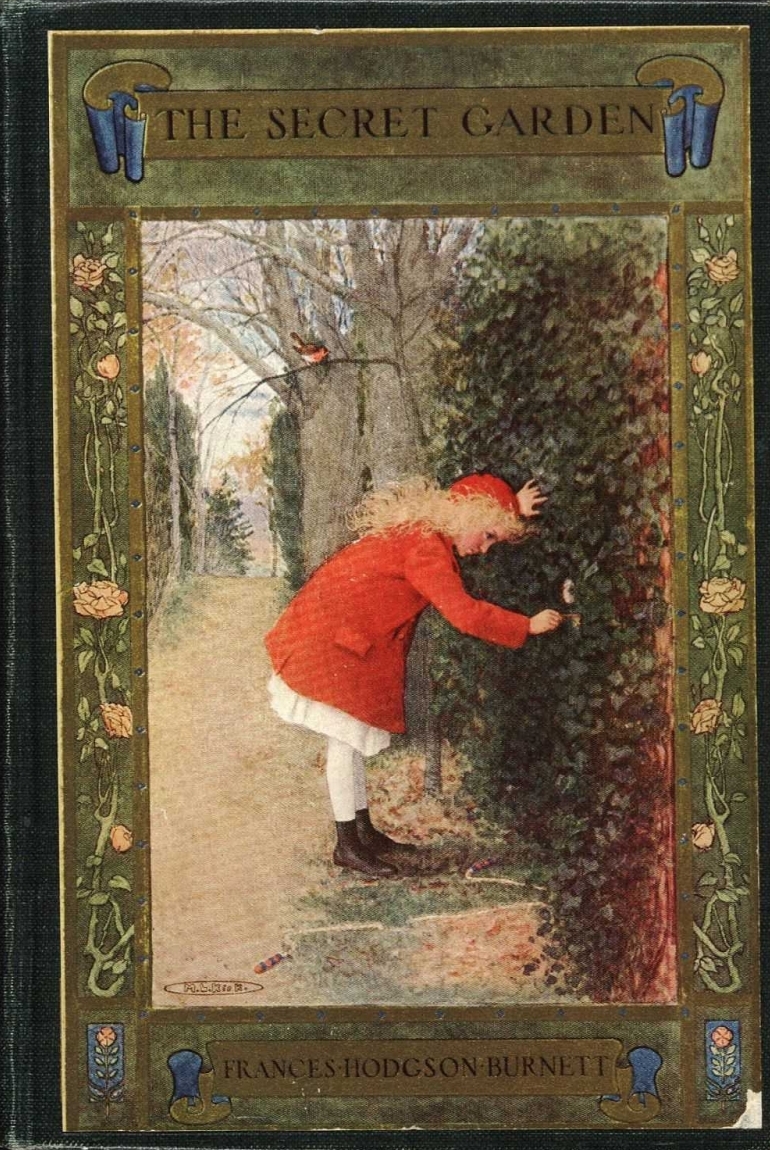
I’ll leave you with a magical observation about children and gardens from one of my favourite early reads, The Secret Garden:

The Secret Garden book coverSometimes since I’ve been in the garden I’ve looked up through the trees at the sky and have had a strange feeling of being happy as if something were pushing and drawing in my chest and making me breathe fast. Magic is always pushing and drawing and making things out of nothing. Everything is made out of Magic, leaves and trees, flowers and birds, badgers and foxes and squirrels and people. So it must be all around us. In this garden — in all the places.

– Frances Hodgson Burnett

***

What is your favourite memory from kindergarten? I liked story time the best (not a surprise to any of you, I’m sure).

Image from Wikimedia Commons

This post is dedicated to Jaso. Thanks for reading!

Stay tuned for tomorrow’s post, where I will lasso the lily-livered letter L…


© Sue Archer and Doorway Between Worlds, 2015

Rogue Words from A to Z: Jealous of Jewelry?

A to Z Letter JShould I be jealous of your fabulously expensive collection of antique jewelry? Or should I be envious?

When I look up envy in my dictionary, it says it is “a feeling of discontented or resentful longing aroused by another’s better fortune.” Okay, then, I must be envious.

But then I look up jealous and it says “envious or resentful of a person or a person’s advantages.” You know you’re in trouble when the word envious is used to define jealous. Should I be jealous instead, then?

What exactly is the difference here?

In practice, people use the word jealousy in a way that overlaps with envy. But there is a distinction between the two terms. After seeing what Grammar Girl had to say and investigating the psychological distinction between the two states, I decided that Common Errors in English Usage has the most useful definition:

You can be envious of what others have that you lack (like a rare and beautiful piece of jewelry).

Jealousy, on the other hand, involves wanting to hold on to what you do have. This is why this term comes up a lot in romantic relationships that are threatened by another person.

So…

Huan_in_shape_of_a_coiled_serpentI am envious of of your fabulously expensive collection of antique jewelry. As your friend, I don’t understand why you won’t let me borrow that sinuously appealing snake amulet to impress my boyfriend. Just once? Pleeeease?

Fine. Clearly you are jealous of your jewelry collection and you don’t want any of it to get lost through carelessness. I guess I can understand that. What I can’t understand is your constant flaunting of your wealth and beauty in front of my boyfriend. I can’t help but be jealous, you know. It’s early days in our relationship. And when you’re around I feel like I’m second best.

Oh, so now you’ve decided to wear that sexy snake amulet when you know we are going out with my boyfriend? For the love of…I thought you were my friend! Hey, you don’t look so good. You look weird. You’re…changing? What the —

Okay, now she’s gone and turned in to a garter snake. Wow, I’m so glad I didn’t wear that amulet. I guess I don’t have to be envious of her good looks any more!

Bonus Word: Jewelry

How do you spell jewelry? The British spelling is jewellery, and the American spelling is jewelry. (As a Canadian, I end up dealing with both of them.) Which version do you prefer?

***

This post is dedicated to Jaso and Brenna Layne.

Image from Wikimedia Commons

Unless otherwise noted, definitions are from the Canadian Oxford Dictionary.

Stay tuned for Monday’s post, when I will kidnap the know-it-all letter K…


© Sue Archer and Doorway Between Worlds, 2015

Rogue Words from A to Z: I Before E, Except After Idiots Drink Too Much Coffee

How many of you had this rule taught to you in school?

I Before E

Except After C

Or When Sounded as A

As in Neighbour and Weigh.

There’s another version of this too, which goes

I Before E

Except After C

When the Sound is EE.

A to Z Letter IThis rhyme would be helpful if it weren’t for those words that are exceptions to the rule. Words like their, weird, and caffeine are some of the more common ones. In fact, there are so many words that are exceptions to the I before E “rule” that some believe it is useless and should be abandoned.

Many of us have had this rhyme drilled into us in childhood and struggle daily with remembering how to spell the exceptions properly. Even drinking several cups of coffee, with all its caffeine, doesn’t keep our brains sharp enough to deal with these weird words.

So for today, I’d like to share a very short parable about coffee to help you recall some of the most critical words that break the I before E spelling rule.

After drinking a surfeit of caffeine, a kaleidoscope of weird images seized their attention like either a scientifically precise heist or a nonpareil sleight of hand. They saw foreign sovereigns leisurely riding feisty heifers of fantastical height. The resulting counterfeit seismic disturbance made them forfeit lunch.

The moral of this story: Don’t drink too much coffee…and be sure to take all spelling “rules” with a grain of salt!

Do you have an ie or ei word that you struggle with? And do you prefer coffee or tea?

***

This post is dedicated to Carrie Rubin.

Stay tuned for tomorrow’s post, where I will take a jab at that jittery letter J…


© Sue Archer and Doorway Between Worlds, 2015