
Carrie Rubin
I am so pleased to be hosting Carrie Rubin for today’s Conversation Corner. I love Carrie’s blog The Write Transition, which showcases her wonderful insights about life and writing. Carrie’s blog has many followers, and yet she somehow finds the time to provide thoughtful answers to every single comment. I am frankly in awe of her mastery of all things media.
Carrie is also a truly funny woman who happens to write novels about disease and serial killers. (Go figure.) Her wonderful second novel Eating Bull has just been released, and I asked her if she would come on by to chat about her experiences writing in the thriller genre. Here is our conversation about teenage heroes, book promotion, health, and funny words.
Carrie, I love the beginning of your About page:
Physician, public health advocate, writer. I believe every experience is worthwhile, even if our paths deviate from where we started.
I hope you don’t mind if I steal that second sentence as an inspirational quote. 🙂 I’ve always felt that whatever we learn is never wasted, since it helps us grow later in ways we couldn’t have foreseen. How have your experiences as a physician contributed to your career as a writer? And what prompted you to make that transition?
Please do take advantage of that quote! Other than my teen sons parroting me in a mocking falsetto, no one ever quotes me.
My medical background plays a big role in my writing, first as a write-what-you-know tool and second as a platform of authenticity. This legitimacy is particularly important for my newest novel, because the social issue at play in Eating Bull is obesity and the food industry’s role in it. Readers want to know the author has experience in the area, and between my years of clinical practice and my public health research, I do.
I have always wanted to write novels. In fact, I wrote my first book fourteen years ago. But as so often happens, life got in the way. So, during a career transition from clinical to nonclinical medicine a couple of years back, I jumped off a cliff and dived into writing instead. (Thanks to the amazing support of my husband whose words at the time were, “It’s now or never.”) Of course, I keep all my medical licensure and public health requirements up to date for life’s next chapter, as well as ties to my hospital of employment, but for now I’m enjoying the life of a writer.
It’s clear in Eating Bull that your authenticity has served you well – including your experience with teen boys! Your main character, Jeremy, is so well drawn. What helped you get into his mindset? And how did you handle the ongoing switch between his point of view and that of adult health worker Sue?
Thank you. My oldest son was fifteen years old when I wrote the book, so having a character the same age as my son helped me get into a teenager’s mindset. Plus, my son served as one of my beta readers. I wanted his opinion on whether Jeremy rang true to his age. If he thought something was off, I fixed the issue. This was particularly helpful in relation to Jeremy’s video game playing and his interactions at school.
Since I enjoy writing in a third-person limited narrative, I had to make sure Sue’s chapters sounded different from Jeremy’s. A 48-year-old woman will have different insights and reactions than a 15-year-old boy. So I tried to don the personality of whoever’s point of view I was writing from. Of course, that meant thinking like Darwin, too. Getting into the mindset of a killer makes for an interesting experience!
I’ll bet it does! I’ve always thought writing thrillers must be challenging because of its inevitable focus on the negative side of human nature. How do you get into that mindset? How do you shake it off? And have you come across any useful resources that helped you write this type of thriller?
I’m not sure I do anything specific to get into the mindset, but when I’m focusing on the negative, particularly when writing from the antagonist’s point of view, I remind myself of Stephen King’s words:
If you intend to write as truthfully as you can, your days as a member of polite society are numbered, anyway.
—Stephen King, On Writing
In other words, I try not to censor myself. As much as my antagonist’s actions might disturb me, they are what fuel the story, and I need to be willing to go there.
I’ve read a variety of books on the craft of writing, but two of the most helpful for me in terms of writing thrillers are Story Engineering and Story Physics, both by Larry Brooks. Structure is very important when drafting thrillers, and I like to have it all laid out beforehand. Brooks’s books help me navigate how to do that.
As you know, I’m a fan of Story Engineering as well. It seems to me that engineering is a perfect concept for a lot of the activities involved in writing a book, including the engineering involved in coordinating its release. How do you handle all the various bits and pieces that are involved in promoting your work?
Honestly, that part’s a bit stressful for me. There is much to coordinate, both online and face-to-face. In the weeks leading up to the book’s release, I:
- wrote blog posts and articles, either for my own site or elsewhere
- sent out ARCs (Advance Reader Copies)
- updated my various platforms and included the book’s links
- contacted potential reviewers
- designed bookmarks and other promotional items
- got emails ready to send to local newspapers, alumni newsletters, and professional contacts
- set up book signings
- created posters for book signings
- developed a “talk” should any speaking engagements arise
- explored other marketing venues
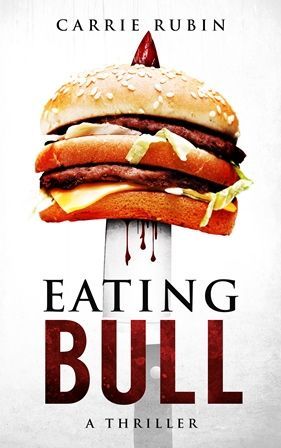 And, of course, during all that I was reading through the final electronic and print versions of Eating Bull before my publisher gave it the official go. It’s amazing how a typo can slip past 2,000 previous readings!
But I handled it like most of us do: making lists and tackling the elephant one bite at a time.
That sure is a big elephant! You’ve talked a lot on your blog about your introversion. As an introvert, how do you keep yourself from running out of energy with all these activities?
The busy work I listed above doesn’t really drain me. It’s the social interactions that do, particularly the face-to-face ones. So now that the book is released, and I’ll be facing more in-person promotion, I’ll need to make sure I get wind-down time every night, either in the form of a good TV show or some reading. Those always help quiet my mind and recharge my batteries, especially if they are followed by a good night’s sleep and a morning workout.
Sounds like an excellent plan. I know I need that recharging time after a busy social day (although I’m still struggling with the workout part). 🙂
You’ve mentioned that the face-to-face interactions involved in promotion are particularly challenging for you. I’ve noticed that you are active on Twitter and Goodreads and comment on many blogs. Do you find communicating through social media to be easier? And how do you manage to keep up with all your online platforms?
I do find interacting on social media much easier. No eye contact, no small talk, and communication in short snippets—perfect for an introvert. In her book Quiet: The Power of Introverts in a World That Can’t Stop Talking, Susan Cain mentions that many introverts thrive online. That being said, I’m a big girl, and I can function in the real world when needed. It just saps my energy more than online communication.
I devote a couple of hours each day to social media, but I don’t keep up as well as I’d like. I do best with Twitter and my blog, but even the latter I find challenging since I follow so many others. While I can’t catch every post, especially on the more prolific blogs, I try to stop by when I can. It’s always fun to see what others are up to, and I’ve found the blogging community to be genuine and supportive. In fact, I’ve ‘met’ remarkable people from all over the world.
I wholeheartedly agree – the blogging community has been wonderful to me as well. And of course I got to meet you! 🙂
I have one last question (one that will hopefully help this introvert impress people at awkward social events): Do you have a favourite obscure or funny medical term?
This is one of those questions where you can’t think of a great answer at the time but later come up with something perfect, usually at three in the morning. But here are a couple of medical terms I like: Borborygmus, which is the term for stomach growling, and myokymia, the term for involuntary muscle twitching, like when your eyelid keeps contracting. And if you have both at the same time? Well…you might want to skip your next meeting.
Thank you so much for having me today, Sue! I had a lot of fun, and I’m honored to be a part of your fabulous blog. For anyone who hasn’t seen Sue’s Rogue Word series yet, it’s definitely worth a look. Lots of great writing tips there. I found the s and apostrophes post particularly helpful.
Thanks, Carrie! I’m glad that my series was helpful for you. And thank you so much for stopping by DBW today and sharing your experiences with my readers!
***
For those of you who enjoy thrillers, I encourage you to take a look at Eating Bull.
And if you’re interested in reading previous conversations on various communication topics, you can find them here. Thanks for reading!

 Doorway Between Worlds