 Sometimes I find the old stories are the best ones. Take Aesop’s fable The Tortoise and the Hare, for example. We can take so many good lessons away from it. The most important lesson: Don’t fall asleep on the job. But we can also use this story to understand the difference between passed and past.
Passed
Passed is the past participle form of the verb pass. When I look up the verb pass in my dictionary, it gives me twenty-one distinct meanings for it. Yikes! Luckily we can ignore all that. Here’s the important thing to remember: Passed is always a verb.
At the start of the historic race, the hare immediately passed the tortoise and bounded away down the lane. He was going to win without a contest, but he ran as fast as he could anyway, because he was a showoff.
After an hour had passed, he started getting hungry from all that sprinting. He decided that he had time to pull over and stop for a snack.
In both of these sentences, passed is acting as a verb. In the first sentence, the verb is acting on an object (to pass the tortoise). In the second sentence, there is no object. But passed is still being used as a verb that describes the action of time passing.
The moral so far: Passed is always a verb.
Past
So what about the word past? Past can function as many different things — adjective, noun, preposition, and likely the kitchen sink, too — but it’s never a verb.
After gorging on berries, the hare felt sleepy and decided to take a nap. As he snored away, the tortoise slowly moved past him and trundled towards the finish line.
At first glance, it might look like past is acting as a verb here. But it’s not. In this case, past is a preposition connecting the verb moved to the pronoun him. It helps tell us where the tortoise is moving to in relation to the hare.
(Prepositions are often used to describe spatial relationships between things. Other examples of prepositions are over, around, and through.)
The tortoise couldn’t believe his luck. In past years, he had always failed to win the race. But this time he was going to get to the finish line first.
This time past is an adjective, describing the noun years. These are not future years; they are past years.
And finally, we have past as a noun.
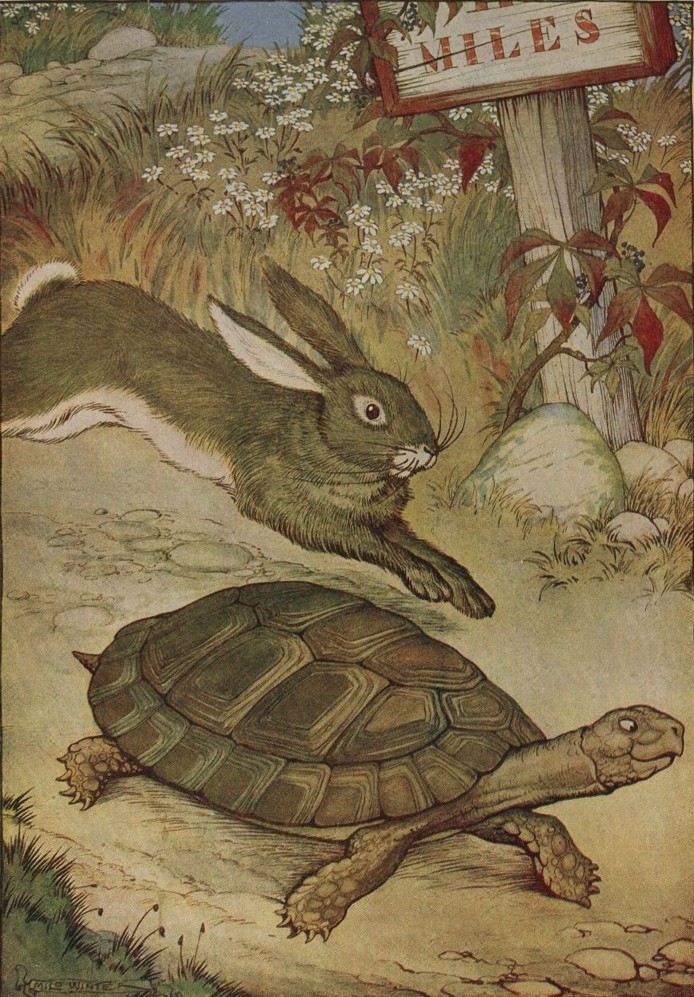 The hare finally woke up, realizing by the position of the sun that he had slept for a long time. He scrambled up and ran as fast as he could towards the finish line. But the tortoise was already there, being patted on the shell by all the other animals.
In a poor attempt to recover his dignity, the hare said casually to the tortoise, “Sure, you won this time because I took it easy on you. But that’s in the past now. Next time I won’t be so generous.”
Unfortunately the referee overheard him and suspended him permanently from racing for his unsportsmanlike behaviour.
The moral of the story: Passed is always a verb. Past is anything but a verb. And don’t be a sore loser. It’s passé.
***
What’s your favourite fable?
Image of Tortoise and the Hare from Wikimedia Commons
This post is dedicated to Shelley Sackier. Thanks for reading!
Stay tuned for Monday’s post, where I will question the quarrelsome letter Q…
© Sue Archer at Doorway Between Worlds, 2015
 Doorway Between Worlds