Big Words, Clean Teeth & Jell-O for Brains: a Lovely Recipe for Life

Today I am holding a special edition of Conversation Corner with children’s author and humour blogger Shelley Sackier on her blog Peak Perspective. You don’t want to miss my first ever illustrated interview! Please come visit and read about our conversation on using large words, writing for children, how to be funny, and the advantages of having Jell-O for brains.

Shelley Sackier's avatarShelley Sackier

Sue Archer: Editor, blogger, and master of not only English but nearly every science fiction and fantasy language to boot. Linguistic skills more impressive than the blinking and confusing cockpit lights of the Starship Enterprise. Have you need of a first-class editor to guide your manuscript to lofty heights of high-class quality? Sue’s your gal. Hungering for a few golden writing tips to sharpen your blog, your essays, your work-related writing skills? Look no further.

Peruse Sue’s new editorial site and her blog site too—and I do mean peruse in the truest sense of the term. DIG DEEP. There is pure gold in them there words.

And if you feel like putting your feet up for a spell, see her fine interviewing skills down below. It was a pleasure and an honor to work with this lovely, talented lady.

A woman with cosmic talent, and universal appeal.

~~~~~~~~~~~~~~~

Conversation Corner with…

View original post 2,162 more words

Quick Poll: Most Annoying Punctuation Mark

Writing a series on how to deal with rogue words was a lot of fun, and now I’m thinking of taking on punctuation. I’ve already talked about everyone’s favourite, the apostrophe, in a few popular posts: Night of the Apostrophe Ninja, Separating Siblings With Apostrophe S, and You’re Not a Yutz. Now I’d like to see if I can make other punctuation marks fun to learn about!

keep-calm-and-use-an-apostrophe

To help me figure out what to focus on, I’d love it if you could let me know which punctuation mark drives you crazy:


Please feel free to share any of your punctuation horror stories below, and I’ll do my best to write some tips that will help!

***

P.S. For those of you who are interested in learning about how art books are edited, I have an interview with award-winning editor Grace Yaginuma this week on the Editors’ Weekly.

How to choose the right editor and editing service, and other great tips with Sue Archer

Today I am chatting about editing with the wonderful Celine Jeanjean at her blog Down the Rabbit Hole. If you’re interested in picking up some tips about editing, please come visit!

Celine Jeanjean's avatarCeline Jeanjean's Blog: Down the Rabbit Hole

Today I’m really happy to be interviewing a blogger a lot of you know: Sue Archer, from Doorway Between Worlds. She has recently launched her new freelance editing business, and today she shares with us some tips and ideas on how writers can select the right editor and editing service for them. I’ve already worked with Sue on a short story and will be working with her on the sequel to The Viper and the Urchin once it’s ready, so I’m very excited to share some of Sue’s expertise with you today.

First of all, thanks for taking part, Sue, and for being on the blog today! Tell us a little about yourself and your editing background. 

Thanks for having me on your blog, Celine! It’s great to have the opportunity to chat with you about editing and share some tips with your readers.

It’s so hard to talk…

View original post 2,220 more words

Attack of the Adverb-Sucking Robot

I believe the road to hell is paved with adverbs, and I will shout it from the rooftops.

– Stephen King, On Writing: A Memoir of the Craft

I can’t count the number of times I’ve read the advice to avoid adverbs when writing. With the way adverbs are vilified, you’d think that inscribing one inevitably causes a writer’s fictional world to collapse.

I read an article last weekend that discussed Stephen King’s take on adverbs and the themes that are raised. It said that writers use adverbs out of fear — fear that their writing will be poor if they don’t use descriptive words.

I think writers are more afraid of being attacked with admonishments about adverbs. They either fear that they have adverbs that weaken their writing, or they fear that removing adverbs in some kind of robotic way will make their writing sound flat.

But you don’t need to be afraid of adverbs — you just need to know when to remove them and why.

Here are three reasons why you might want to remove an adverb:

  1. The adverb is redundant. Having two words that mean the same thing weakens the sentence rather than strengthening it.
  2. The adverb is a useless intensifier like “very” or “really.” These intensifiers are overused and have become meaningless.
  3. The adverb is telling the reader something that should be shown instead. (This relates to another common piece of writing wisdom: “Show, don’t tell.”) The adverb is compensating for something that is missing from the scene. Instead of using an adverb to convey something, it would be better to add in some details that remove the need for an adverb.

To illustrate all this advice, I have written a short story. It’s not all that scary, I promise.

Imagine if someone invented an amazing yet intimidating new writing tool: an adverb-sucking robot.

Attack of the Adverb-Sucking Robot

Adele was at her desk, writing. She saw a shadow creep over her desk and looked up. Not again, she thought.
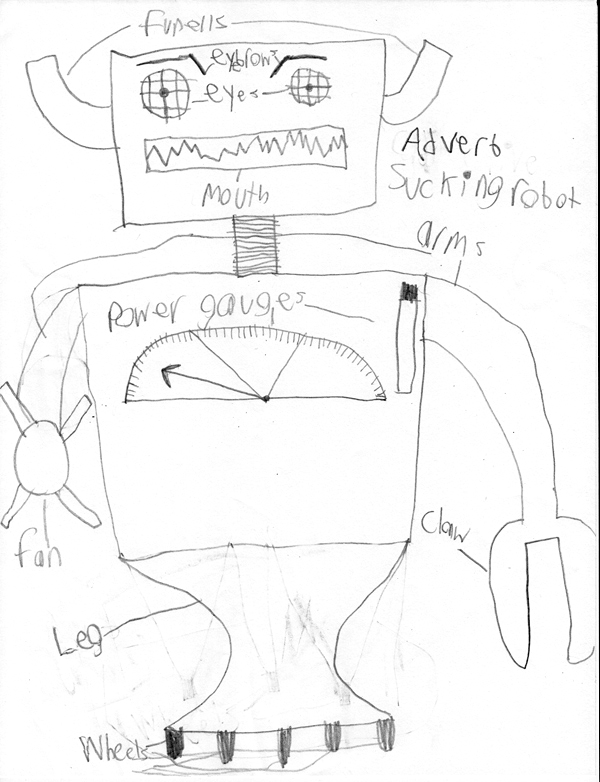
Adverb Sucking Robot

“Why won’t you just leave me alone? I can’t concentrate with you hovering over me!”

Beep beep beep.

“Okay, so I wrote a few adverbs…big deal! What do you know, anyway?”

BEEEEEEP.

“Fine. I’ll show you adverbs!” Adele scribbled a sentence.

The robot stood menacingly over me.

The dreaded roaring noise began. Adele slammed her hands on the paper as the air was sucked away from her desk. But she knew it was useless. The words now read:

The robot stood over me.

“Now look what you’ve done! This is boring. Where’s that sense of dread I get every time you invade my life? I need to tell them exactly how I feel about you, you tin monstrosity.”

Boop. A brief rush of air ruffled the page.

The robot towered over me.

“Hmmm…okay, I admit that towered is a strong verb. But that’s not saying enough about how I feel. I need to add something…” Adele concentrated, then wrote another sentence.

I was really afraid that the robot would destroy my writing.

“There! Argue with that, you interfering hack. I dare you.”

ROARRR…

I was afraid that the robot would destroy my writing.

“But I’m not afraid! I’m really afraid. I’m…I’m…”

Boop.

I was terrified that the robot would destroy my writing.

“Yes, terrified – that’s it. Because how can you possibly have any good judgment on this? You’re a robot, not a writer…you don’t feel things the way people do. Speaking of which…” Adele wrote another sentence with a flourish. “Witness the truth of your existence.”

The robot unfeelingly sucked away all her adverbs.

Roarrr…

The robot sucked away all her adverbs.

Adele stared at her paper and waited. But nothing happened.

“What, no boop this time?”

Silence.

“Oh, I get it. A robot is obviously unfeeling because it’s a robot, so I don’t need to tell anyone that. It would be redundant.”

Wheeee.

“Why are you making that noise? I must admit that’s an improvement. But I’m confused. Hang on…”

She shook her head confusedly.

“No, wait, don’t say anything —”

Adele scribbled.

She shook her head confusedly.

“We already know I’m confused, right? Because your behaviour is so different from before. So I don’t need an adverb to tell anyone that!”

WHEEEEE.

Adele thought maybe she could get used to that new sound. She looked over her page and realized that her writing did look better.

She smiled happily.

***

Thanks to my wonderful son, who gave me both the idea and the stellar drawing.

What do you think about using adverbs? Do you have words that you watch for, and how do you deal with them? (I sometimes use the Hemingway app to find adverbs in my own writing.)


© Sue Archer and Doorway Between Worlds, 2015
DBW Review: Self-Editing for Fiction Writers by Renni Browne and Dave King

I picked up Self-Editing for Fiction Writers by editors Renni Browne and Dave King because several of my editing colleagues recommended it as a solid resource for authors. There are many books on how to write and comparatively few on how to edit your own writing. Yet this is such a critical task for writers if they want to submit a solid manuscript for further editing or publishing. I was really looking forward to reading through this book, and I’m glad to say it was a winner.

Self-Editing for Fiction WritersSelf-Editing for Fiction Writers is focused on the details of stylistic editing. The authors assume that you have already dealt with the larger structural concerns of plot, character arc, and theme. The book covers a broad range of topics relating to the mechanics of editing: showing vs. telling, characterization and exposition, point of view, proportion, dialogue, interior monologue, sound and voice, repetition, and scene beats and breaks.

What I Liked

I mentioned that a lot of topics were covered in this book. Each of them are discussed in a great amount of depth without becoming overwhelming. The authors cover several angles and explain why certain situations require different treatment from others.

I particularly enjoyed the chapter, “Show and Tell,” which brings new life to the old chestnut that you should be showing something to the readers rather than telling them about it. All writers receive this advice at some point, but Browne and King bring a balanced perspective to the discussion, clearly illustrating when to use show and when to use tell.

To write exposition at length — describing your characters’ pasts or events that happened before the story began or any information your readers might need to understand your plot — is to engage your readers’ intellects. What you want to do is engage their emotions. (p. 10)

The writing style is clear and engaging, and avoids the lecturing style that sometimes happens with “how to” books. Editors have a somewhat unfair reputation as nitpicking sticklers, and I’m happy to say there is no sign of that here — instead, the authors are positive and supportive as they outline the issues that writers often struggle with and potential solutions.

Plenty of examples are used in each chapter to illustrate the points, and at the end of each chapter there are useful checklists as well as practice exercises.

What Could Be Better

This book is so well-written that it was difficult to find any issues with it. However, as we writers know, there’s always something that can be improved!

Most of the examples in the book are bracketed with detailed explanations of what the examples are illustrating. Once in a while, though, an example is thrown out where the authors assume that the reader will identify what is right or wrong with the passage without help. One place that stood out for me was in the chapter on “Voice,” where the authors provide an example of five different character monologues from the same book and say, “Every voice is distinct.” How they are distinct is never explained, and I feel this weakens the helpfulness of this example.

My only other wish is that the book contained even more practical exercises. There are usually about three per chapter, and having more (and shorter) exercises would make this resource even more valuable.

Favourite Learning Moment

My favourite part of this book is not a particular moment but an overall thread that gets woven throughout the narrative. There is a lot of focus in the book on how to bring out characters and their emotions. The authors discuss several areas where these can be displayed, such as through dialogue, interior monologue, and exposition from the character’s point of view. They also talk about how character development can be combined with the advancement of plot, the establishment of setting, and the revelation of key information.

If each element of your story accomplishes one thing and one thing only, then your story will subtly, almost subliminally, feel artificial. When everything seems to be happening at once, then it will feel like real life. (p. 183)

Verdict

This is the best book I have ever read on how to edit your own writing. Pick it up, read it, and read it again. You won’t regret it.

***

If you are interested in reading about other writing resources, you may want to take a look at my Resources page. And if you’re looking for more tips on self-editing, I have recently written a post on why you should try a style sheet when editing your work.

What do you find is the most challenging aspect of self-editing? Which resources have helped you with this difficult task?


© Sue Archer and Doorway Between Worlds, 2015

Announcement: My New Editing Site

Dear readers,

A couple of weeks ago I mentioned I was working on a new project. Well, here it is — my brand new editing site — Sue Archer, Wordsmith. I’m excited to share it here with all of you!

In addition to my day job, I have recently started up my own freelance editing business. Collaborating with self-publishing authors has been such a rewarding experience for me. I’d love to have the opportunity to work with some of you someday. 🙂

If you have the time and the interest, I’d appreciate it if you could visit my site and let me know what you think in the comments below. Please be honest — I consider it a work in progress. I have also started up a blog on my new site that will be focused on editing and self-publishing tips for writers. If you feel that’s something that would be useful for you, please feel free to follow.

Doorway Between Worlds won’t be changing – I’ll be continuing to blog about communication here, and I won’t be doing any more posts advertising my services.

And finally — in the spirit of “the big reveal,” I thought it was time that I showed all of you the real me behind the avatar:

Sue Archer, Wordsmith and Editor

Thank you to all of you for your support!


Sue

The Many Ps of Book Marketing

I love learning, and the Editing Goes Global conference was a great opportunity to pick up all sorts of useful knowledge. Last week, I shared some tips from editor Arlene Prunkl on how to write good comments. Today, I want to pass along some nuggets of wisdom I learned from Beth Kallman Werner in her session “The Many Ps of Book Marketing.”

Ms. Werner has worked as the Director of Sales and Marketing at Kirkus and is the founder of Author Connections. She has over twenty years of experience in editing and marketing, and it definitely showed in her presentation. I was scribbling notes like mad. I couldn’t possibly include all of her thoughts here, but I thought I’d share some of the highlights.

Her session focused on the four Ps of marketing (product, position, price, and promotion) and how they relate specifically to book marketing.

Product

Werner started off by discussing some of the misconceptions about marketing, including the idea that marketing is disconnected from other parts of the publishing process. Marketing doesn’t begin after the book is finished — it needs to be considered right from the beginning.

If you want people to invest their time and money in your book, then you need to start with a quality product that will engage your audience. This seems like an obvious point, but part of creating quality is thinking about your potential readers as you are writing the book. Who is your target audience? You want to know this from the beginning. Engage with your audience in advance of writing, so you know who you are writing for and what they need.

Position

How can you position your book so that it is appealing to your audience? Readers look for different things when deciding whether or not to pick up a book.

Decisions, decisions a tower of used books

Decisions, decisions…

Here are some things to think about.

  • Will the cover get their attention?
  • Is the blurb appealing? Many readers will buy a book on the basis of the blurb alone.
  • Does your book have reviews of your work on the cover (or elsewhere)?
  • Is your book about a timely topic?

One interesting tidbit that Werner shared is that readers generally don’t care about who has published the book. So being self-published is not a strike against you. The exception to this is certain areas of non-fiction, where having a recognized name behind you (like a university press) can go a long way.

Even if you position your book well, it may still take some time before you see a substantial readership. Werner mentioned that it is not uncommon for this to take 18-24 months.

Price

The number one consideration here is whether your target audience can afford your book. Sometimes it makes sense to release an e-book first and see how it makes out before investing in the costs of printing. You don’t need to take on everything at once.

If you have a global audience, then you may need different prices for different regions, based on what is considered reasonable.

During the session, someone asked whether it made sense to have free giveaways of your book. Werner mentioned that there are four reasons for considering a giveaway:

  • To launch a product or a brand (and you are a brand)
  • To generate leads and sales (for example, if your main income is not from books, you could give away a book at a speaking engagement to generate other business)
  • To maintain your brand (if you have been away for a while)
  • To perform damage control (when something has gone wrong)

Promotion

A lot of discussion took place in the session on various aspects of promotion. There are so many ways to promote your book: blogging, SEO, social media, direct mail, readings and signings, events, print advertising, online advertising, etc. You can’t possibly do them all. Think about what you are comfortable doing and then determine which of those tactics will be effective for your book.

If you decide to go ahead with an event, for example, think about whether your target audience will be at that event. Where will you be branding yourself best?

Don’t forget about your budget. Will you be getting a return on your investment?

As a blogger, I definitely sat up when Werner started talking about blogging. She said that lots of people tell authors they need to have a blog, but this isn’t always true. Books have a 100% attrition rate — no one is going to buy your book twice. So if you have a blog with 200 followers, how many books are you going to sell directly through that blog?

Werner believes that blogs are beneficial for non-fiction writers to show their expertise. They are also good if you have something new and compelling to say. Otherwise, they are a huge time commitment, and you may be better off focusing on writing your book.

If you are going to blog, make sure you get things to people when they are the most receptive to reading (based on time zone).

The bottom line: Will your blog help you sell books?

I could go on and on, but I’ll have mercy on my readers and stop here. As a final note, I thought I’d share one of Werner’s other myths about marketing: Marketing is an unbearable chore. As she puts it, marketing is to “take on the fun of sharing what you’ve done.” You can tell she really loves her work!

***

For those of you who are writers, do you have marketing tips to share? Do you agree or disagree with Werner’s position on having a blog? For readers, what do you look for when deciding whether or not to buy a book?

Image © Jorge Royan / http://www.royan.com.ar/ CC-BY-SA-3.0


© Sue Archer and Doorway Between Worlds, 2015