Universal Translator: Noun

Noun. A part of speech that caters to the human obsession with naming objects. Loosely identified by a primitive human song as “a person, place, or thing.”

(Side note: A formal protest has been lodged with the Galactic Council against human identification of other intelligent beings as “things” and not “persons.” Judgment is still pending.)

Types of Nouns. Humans like to categorize things, and have divided the simple noun into several unnecessary types.

Concrete Noun: An object, substance, or being that can be perceived using the senses (hut, dirt, sword). Humans rely mainly on their eyes, but can also sense things through their ears, mouth, nose, and skin. As their empathic sense is virtually non-existent, they do not consider emotions to be concrete nouns. (See: Abstract Noun.)

Abstract Noun: A thing that can only be understood by the mind, such as a concept (ignorance), a quality (ugly), or a measure (year). Some have expressed surprise that humans are capable of abstract thought. Evidence supports that they are capable, but illogical measurements such as the cubit prove that humans have not evolved competence in this area.

Countable Noun: Something that can be counted. Humans enjoy the repetitive action of counting items such as coins. (As proof, they produce physical tokens of money, even though these tokens are universally obsolete among all higher beings.) English-speaking humans assign a special importance to these nouns by adding an “s” to a countable noun when there is more than one, such as one dollar and two dollars. They also compare the amounts of countable nouns by saying things like, “You have fewer dollars than I have.”

The Money Changer and His Wife

An example in human art of their foolish focus on coin counting

Non-Countable Noun: Something feared and avoided by humans, since it cannot be counted and assigned the special “s” at the end of the noun. Examples include pollution and salt. Comparing amounts of non-countable nouns is handled by saying things like, “My meal has less salt than yours, and so I will live longer.”

Collective Noun: A noun that represents more than one person or thing, such as a flock of humans or a chorus of vehicles. These nouns confuse humans because they are usually treated as singular even though they refer to more than one item.

Common Noun: A noun that has no specific importance, and is not capitalized. Almost all nouns are common nouns.

Proper Noun: A noun that humans have decided is special, and warrants a capital letter at the beginning of the word. Examples include the name of a specific person or place. Humans continue to debate whether the name of their planet should start with a capital letter. Galactic grammarians are also divided on this point. Some argue that Earth should be capitalized, since it is a specific planet. Others argue that a backwater planet named after something as common as dirt has no importance.

Entry submitted by The Learned Dresgjas Sjart-Iiih of the planet Jassssh

(Editor’s Note: Clearly biased against humans. Find someone with more experience of Earth for future entries.)

***

Image credit: Wikipedia Commons, The Money Changer and His Wife

This is the first in my new series called Universal Translator. As some of you may have noticed, I was channeling The Hitchhiker’s Guide to the Galaxy when I wrote this. 🙂 This series will feature entries from different beings around the universe, who will bring their unique perspectives to the study of the English language. As always, your thoughts and comments are welcome!

DBW Review: Grammar Girl’s Quick and Dirty Tips for Better Writing

Welcome to my first DBW Review! In this series, I will share some of the resources that have helped me develop my communication skills.

Grammar Girl's Quick and Dirty Tips for Better WritingI’ve talked about Grammar Girl in some of my previous posts. Her real name is Mignon Fogarty, and she started out producing short podcasts to help people understand language rules. She has a website called Quick and Dirty Tips, where she posts her podcasts as articles. Her site is one of my go-to sources for grammar information, and so I decided to pick up a book she wrote called Grammar Girl’s Quick and Dirty Tips for Better Writing.

What I Liked

Fogarty’s writing style is consistent with her podcast voice: friendly, fun, and knowledgeable. She shares her tips on various grammar and writing challenges in an approachable way and never talks down to her audience.

Pronouns are words that stand in for nouns. They’re pros, like stuntmen. When Aardvark, Squiggly, and Grammar Girl are feeling overworked, they call in a pronoun. Because pronouns don’t get the same recognition as the big stars, they’re a little temperamental. It’s their way of getting even. (139)

She includes a broad range of topics in her book, from common grammar and usage issues to advice on writing style. My favourite section is called “Punch Up Your Punctuation,” where she goes through all of the essential elements of punctuation in detail. (In keeping with Grammar Girl style, the sections are named things like “Comma Comma Comma Comma Comma Chameleon” and “The Question Mark: Huh?”)

Fogarty uses a lot of great examples to illustrate her tips. Two cartoon characters called Aardvark and Squiggly entertain us with their antics while helping us learn. There is also a fantastic appendix called “Quick and Dirty Grammar at a Glance,” which summarizes the most important tips in five pages. (The book has other useful appendices as well, like lists of irregular verbs and subordinating conjunctions.)

What Could Be Better

I attempted to read this book from front to back, and got overwhelmed at the beginning with the large first chapter on usage (called “Dirty Words”). This chapter includes many small sections on word confusions like your vs. you’re and affect vs. effect. The later chapters on topics like capitalization and pronouns are more coherently presented and can be read straight through. I think the usage section is useful to consult when you need it, but it’s not something you are going to want to read like a chapter book.

The book is designed to cover many topics quickly, at a level that works for most audiences. One thing I missed was the in-depth background information that Grammar Girl provides in her podcasts. If you’re looking for a detailed explanation of why a certain rule exists, you won’t find it here. For that level of information, I would encourage you to go to her website. (She is also on Twitter as GrammarGirl.)

Sci-Fi/Fantasy Connection

Since this is Doorway Between Worlds, after all, I kept an eye out for any sci-fi or fantasy fun. Fogarty tells us on page 57 that she is a Star Trek fan. (She uses this show in some of her examples.) For those of you who may be wondering: her favourite series is Star Trek: The Next Generation, followed by Star Trek: Deep Space Nine.

Verdict

Grammar Girl was one of my big inspirations for starting my own blog, and I’m happy to see that her focus on fun in education is alive and well in this book. Whether you are a novice at grammar or an experienced writer who is struggling with a specific usage issue, this book has something for you. It’s a great summary resource of writing tips.

***

Disclosure: I am not being compensated in any way for this review. Just in case you were wondering. 🙂

DBW Reviews is a new post series, and I welcome your feedback on whether this review was helpful for you. Please feel free to comment below. And if you have other great writing or grammar resources you’d like to share, please do!

Life, the Blogosphere, and Everything: Changes Coming to DBW

Today’s post is a smorgasbord of poll results, life events, and announcements of blog changes here on DBW.

I was realizing today that I have been blogging for almost six months. When I started this blog, I had a goal of creating one post a week. I am happy to say that I’ve been able to do that, and it’s been a fantastic experience for me. I love sharing what I’ve learned about communication in creative and fun ways. And I’ve met some great people!

But I still have more learning to do. Although I have spent years writing and editing in my various day jobs, I’m constantly looking for ways to learn more and improve my skills. (If I could get paid to learn, I would take that job in no time flat!) So I’ve decided to take a university course in substantive and stylistic editing this fall. I am looking forward to this course a lot, but it means that I will have less time for blogging over the next three months. The good news is that I will be able to take all of those juicy tidbits I pick up from my course and share them with you. But if you don’t see me for a little while, it’s because I haven’t had time to post on them yet. I think I am going to be doing more liking than commenting on your blogs, too, since I will only have so much time to read! Please bear with me as I learn more about how to help writers craft a great book.

blogging

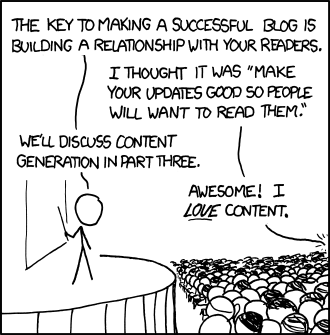
Don’t worry, content is coming! Source: www.xkcd.com

I also wanted to let you know that the content of my posts will be changing (more like expanding). Back in August, I posted a poll asking you, dear readers, what you would like to see more of on my blog. Thank you to those of you who participated. Here’s a summary of the results:

Most of you liked anything to do with communication, whether on writing topics or on other topics. So I’m not going to try to specialize in any particular communication topic, but will keep providing variety. I tend to slant more towards writing topics, so that will probably keep happening.

The top two new post ideas that you liked were definitions of terms and recommended resources. So in the future, I am going to post four types of posts:

– The “story” posts, where I will weave writing and grammar tips into a fictional story setting.

– The “metaphor” posts, where I will use TV, movies, and sci-fi/fantasy pop culture to illustrate points about communication.

– A new series of posts called “Universal Translator,” where I will pick a tricky term and define it using fun sci-fi/fantasy sentences. (This includes confusing usages of similar terms, like effect vs. affect.) I need your help with this one! In the comments, please post any terms that you’d like to see defined. (I remember the first time I saw the term “dangling participle” on a returned essay, and was embarrassed because I had no idea what a participle was. So please don’t be shy! Share any terms that you think are tricky. Otherwise I will inflict my own terms on you! Bwah ha ha.)

– A new series of posts tentatively called “DBW Discoveries,” where I will share my thoughts on different communications learning resources – books, websites, you name it. (I have some current faves, but I’m sure I’ll be finding more in my upcoming course.) I’m always on the lookout for good sources of learning, so please feel free to post any in the comments. If you know anyone who’s written a helpful resource, I am happy to read through it and provide an honest review.

I hope you will enjoy the changes, which I’ll be adding in gradually over the next little while. Any feedback is appreciated!

Thanks for making this such a fun ride. I’ll see you again soon, whenever I have time to pull myself out of the books. 🙂

All the best,

Sue

Female Superhero Movie Franchises: What Would Ellen Ripley Say?

For those of you who enjoy my posts on movies and superheroes, I have a guest post on Andrew Knighton Writes today that you may wish to check out. Thanks for hosting me, Andrew!

andrewknighton's avatarAndrew Knighton writes

A special treat today – I have a guest post from Sue of the Doorway Between Worlds blog. I’m a fan of the way Sue uses science fiction and fantasy to explore topics around communication, and it’s a pleasure to host her opinions on another topic here today, one that I’ve touched on in the past. So without further ado…

Female Superhero Movie Franchises: What Would Ellen Ripley Say?

When I was eight years old, my parents gave me a copy of The Lion, The Witch, and the Wardrobe. I devoured the story, identifying with the plucky character of Lucy. I then went on to read A Wrinkle in Time, and got drawn in to the world of Meg Murray, who was geeky (like me) and who saved her brother from evil. And I knew: science fiction and fantasy were written for me. This was a genre…

View original post 841 more words

The Time Traveller’s Verbs, Part 3: To Save Our Future

In Part 2 of The Time Traveller’s Verbs, the Captain and Sergeant Joe explained past tense verbs to Kevin, Mia, and little Zifnat, with some help from Isaac Newton and Leonardo da Vinci. (If you missed the first installment and would like to read from the beginning, you can find Part 1 here.) With little Zifnat now tucked into bed, Kevin and Mia are ready to hear about the future.

The Captain focused her steady gaze on Kevin and Mia. “What we’re about to tell you is something that you cannot share with anyone else. We think you’re old enough to hear this, but you have to understand that the future is not something you can take lightly. Do you swear to tell no one about what you hear tonight, recruits?”

“We swear,” said Mia. Kevin nodded.

“Well, then,” said the Captain. “If the time traveller’s verbs are important, then the future tense is the most important of all. Anything that we do in the past or the present can change the future. Some changes are small, and don’t affect much of anything. But other changes result in a significant shift in the timeline. Most of the time, our job is to prevent these shifts from happening.”

“But sometimes,” said Joe, “our job is to deliberately shift the timeline. Which is what we’ve been doing tonight.”

“To explain all this, we’re going to use the four future verb tenses: simple, continuous, perfect, and perfect continuous,” said the Captain. “This time, I want you to tell me what tenses I am using. Let’s see how well you’ve learned your verb lessons.”

Simple Future

“I’ve seen many different timelines over the years,” said the Captain. “But no matter what changes, there is one event that has always remained the same.

“Several years from now, an alien race called the Kcchx will attack the Earth and will attempt to destroy us.”

Mia made a squeaking noise. Kevin’s eyes widened.

“Kevin,” said Joe, “what tense was the Captain using?”

Kevin stared at Joe. “You want me to think about verb tenses after hearing that? Are you crazy?”

“Kevin!” snapped the Captain. “Show some respect. And have some faith. The story’s not over yet, boy.”

Kevin narrowed his eyes. “It’s the simple future – you’re using will with the base form of an action verb. Duh. Not that it matters, since we’re all going to die.”

“Of course it matters,” said the Captain. “You weren’t paying attention to what I said.”

“You said that they will attempt to destroy us,” said Mia. “Not that they are going to destroy us.”

“Exactly. Those statements are both expressed in the simple future tense, but I use are going to only for definite events. And for a time traveller, the future is never definite.”

“The Captain and I and our fellow time travellers have been working hard to ensure that the Kcchx will not succeed,” said Joe. “We’ve been observing great moments in history, and trying to make small changes in how the human race has approached science and technology. To change the future, we needed to meet the Zardonians before the Kcchx started to arrive. And now we have met them.”

“Of course we have,” said Kevin. “The Zardonians have always been around!”

“Not quite,” said the Captain. “But you wouldn’t remember any differently. When the timeline changes, your memory does, too.”

“Cool,” said Mia.

Future Continuous

“Here’s another sentence for you,” said the Captain. “Joe and I will be continuing to make sure that a bad future doesn’t happen. Mia, I’m sure you can spot the tense on this one.”

“That’s easy, Captain. It’s the future continuous tense, which you use to talk about ongoing events in the future. Or, should I say, continuing events,” said Mia. She laughed. “You gave it away!”

“Oh, so I did,” said the Captain. “I must be getting old.” Mia laughed again. Kevin started to look a bit less grim.

“Joe, why don’t you share our time-travelling brilliance with our recruits here, and teach them their last two verb tenses.”

“My pleasure,” said Joe.

Future Perfect

“Now that we’ve met the Zardonians, we’re in great shape for the future,” said Joe. “Visiting da Vinci and getting him to think differently about flying machines was the last piece of the puzzle. The rest of our team has been visiting other points in time, and influencing the direction of our technology. So now we have been able to successfully contact the Zardonians. The Zardonians know a lot more about the galaxy than we do. By the time the Kcchx arrive, we will have learned all about them from our Zardonian friends. Do you recognize the tense, Kevin?”

Kevin looked more relaxed. “You’re talking about a future event that will be completed before another event. We’re going to learn about the Kcchx before their arrival. So this must be the future perfect tense!”

“Perfect,” said Joe. “This means we have one more tense left. Mia?”

Future Perfect Continuous

“The future perfect continuous tense,” said Mia. “I think I remember some of this from Mom’s old training program. It said to imagine that you are in the future, looking back on an event that has already started and is still ongoing. You would use this tense to talk about it, with the verbs will have been and an -ing form of an action verb.”

“Wonderful!” said the Captain. “Mia, I am impressed.” Mia beamed.

“By the time the Kcchx are ready to attack us, we will have been working with the Zardonians for many years to improve our capabilities. The Kcchx will be stopped in their tracks,” said Joe.

Space Battle

“So, Earth is safe?” asked Kevin.

“Yes, Earth is safe,” said the Captain. “Joe and I have seen the new future, and humans are doing well.”

“What happens to Kevin and me?” asked Mia. “I know we’re not supposed to ask, but…”

“We can’t tell you that,” said Joe. “But we can tell you that you will make us proud.” Kevin and Mia looked at each other and smiled.

“All right, it’s time for bed for you two. Your lesson is over,” said the Captain. “Joe and I are going to sit out here for a bit before we turn in. Sleep well, recruits.”

With a chorus of goodnights, the two of them left for their portable sleeping cubicles.

The Captain and Sergeant Joe sat next to the campfire in silence for a while. Joe toasted two of the Zardonian berrymallows and offered one to the Captain. She shook her head. Joe ate one and winced. “I guess not everything is better,” he observed.

The Captain sighed and shifted her weight on the anti-grav platform. “You’d think they could have come up with more comfortable chairs. I’m getting tired of this, Joe.”

“Maybe it’s time for you to retire, Captain,” said Joe.

The Captain gave him a look.

“No disrespect intended,” said Joe, and saluted.

The Captain turned back to stare at the dying fire. “I will someday, Joe. But not until I am sure that those youngsters will be safe. You know how easy it is for things to change.”

Joe’s pocket beeped. He pulled out his comm unit and looked at the screen. “Speak of the devil,” he said. “It looks like our favourite King Richard is acting up again.”

“Gah! Not that pompous windbag. Please tell me we’re not going to war.” The Captain and Joe stood up and walked into the darkness.

“Oh, but I know how much you love using a sword,” teased Joe.

“You’d better be careful or I’ll show you how well I can use it, Sergeant. I’m not that old yet.”

Their voices faded away.

There was a flash of blue light, and something changed…

***

So ends the tale of The Time Traveller’s Verbs. Thanks for reading my epic verb saga. Looking for more fun with verbs? See my previous posts about verb moods and action vs. linking verbs.

My son, the master artist, provided the picture for today’s story. I think I owe him an ice cream now. 🙂