Me, Myself, or I—Whodunnit?

I’m dealing with a pronoun identity crisis. It’s like trying to pick a clone from Star Wars out of a lineup. Me, Myself, and I are all possible suspects. Which one should I use in my sentence? With the help of Anne Stilman (and with apologies to Jango Fett), I’m going to sort out these annoying pronoun clones once and for all.

Suspect Number One: I, the Arrogant Subject

Jango Fett from Star Wars

I am in control of my destiny!

 I is a “take charge” kind of pronoun. I demands pride of place as the subject of a sentence (the person committing the action).

I will lead my troops to victory! ✓

I continues to demand this right even when there are other subjects in the sentence.

Yoda and I will never be good friends. ✓

I hates it when someone writes Yoda and Me. ✕   This is simply disrespectful.

I also barges in when there are comparisons between two subjects. I shows up even when there is no verb following it.

Mace Windu thinks he is better than I. ✓

In the sentence above, the verb is implied. The full sentence is below.

Mace Windu thinks he is better than I am. ✓  (What a fool!) ✕

I wants you to know that missing words don’t excuse you from getting this right. Don’t screw it up by saying Mace thinks he is better than Me. ✕

I is also arrogant enough to crowd in directly after a verb, when the verb is a form of to be (is, am, was, were).

It is I, the great clone warrior! ✓

In this case, I is following a linking verb (is). A linking verb links the subject to the item that follows it. It (the subject) = I (the subject).

I wants us to understand that I is clearly > Me, so It is Me is ridiculous. (Although this usage is increasingly accepted—for another view, check out Grammar Girl’s take on “It is I.”)

Bottom line, I is an attention hog and a horrible dinner companion. Enough said.

Suspect Number Two: Me, the Objectified Victim

Jango Fett from Star Wars - 2

Why is everyone always bothering me?

Everyone is always out to get Me. Instead of being a subject, this pronoun is treated as an object. Verbs are constantly acting against Me.

They are all plotting to dispose of Me. ✓

Since I is a hog, it likes to kick Me out of its rightful place when there are multiple objects in a sentence.

The Jedi are pestering Boba and I. ✕

This is completely wrong, and makes Me suffer. Here’s the correct version.

The Jedi are pestering Boba and Me. ✓

On a bright note, there is one sentence where Me is not the underdog.

Woe is Me. ✓

At first glance, it looks like I should be taking over this sentence. (Remember when I followed the linking verb is in It is I?) Not so fast. This is another sentence with some implied words.

Woe is delivered unto Me. ✓

Me continues to be an object here, as the receiver of a delivery. So Me wins this round (if you can call it winning).

How appropriate that we are talking about woe around such a moping and hard-done-by pronoun. Let’s move on from Me—the party pooper.

Suspect Number Three: Myself, the Perpetual Sidekick

Jango Fett from Star Wars - 3

I really need to stand up for myself.

Myself really needs a mind of its own. Instead, it follows I around everywhere, feeding I‘s superiority. This is why Myself is known as a reflexive pronoun. It is a reflection of I.

I can’t fight this war all by Myself! ✓

(Guess it’s time to make some more clones then.)

Sometimes Myself tries to rise in importance by acting as an intensive pronoun. Myself intensifies what I is saying.

I Myself believe that war is the only true answer. ✓

This is a correct sentence, but Myself is still following I around, so I’m not sure how successful its ploy for greatness is.

In a last bid for glory, you can find Myself trying to act like a subject or an object.

Dooku and Myself are clearly both subjects. ✕

The Jedi insulted Myself and my other clone brother objects. ✕

The pronoun should be I in the first sentence, and Me in the second one. Myself is out of luck. It continues to be a tagalong pronoun. No wonder it got dragged into a lineup with the other pronoun troublemakers!

I think my pronoun identity crisis is over. The verdict? All of them are still annoying. But at least I know when to use them in my sentences. Now if only they can stay out of trouble!

(Have you experienced pain with pronouns? Are there any particular grammar challenges you would like to see me tackle here? Please share your thoughts below.)


Which Avenger will you be today?

With Captain America: The Winter Soldier out in theatres, I have Marvel superheroes on the brain. And I’ve realized that Marvel’s The Avengers is not just a story about a superhero team—it’s a story about communication.

Samuel L. Jackson’s Nick Fury spends the first half of the Avengers movie gathering the team and trying to get them to work together. This is an uphill battle, largely because of the team members’ different communication styles. They may be talking to each other, but they are not communicating. It’s only when they learn to adjust their styles that they become an effective fighting force.

If you want to work well with your own team, you may need to adjust your communication style. Ask yourself: Which Avenger should I be today?

Let’s take a look at some of your options.

Iron Man

“The Avengers. It’s what we call ourselves, sort of like a team. ‘Earth’s Mightiest Heroes’ type of thing.”

Iron Man (Tony Stark)

Communication Style: Informal

Iron Man is the life of the party. He’s the casual genius who talks a lot and makes people laugh. It’s time to be Iron Man when you are hanging out with good friends and colleagues or writing a friendly note to someone you know well. Just be careful you don’t let your words run away from you—sometimes Iron Man can talk too much and annoy supervillains. Bad idea.

Thor from the Avengers

“So you take the world I love as recompense for your imagined slights?”

Thor

Communication Style: Formal

Thor is a Norse god, so he uses formal language and makes solemn pronouncements. You may need to channel Thor when you are speaking with strangers, apologizing to unhappy customers, or writing up a business proposal. Just don’t come across as too formal—otherwise you’ll be known as the unfriendly person with the scary hammer.

Captain America

“I went under, the world was at war, I wake up, they say we won. They didn’t say what we lost.”

Captain America (Steve Rogers)

Communication Style: Direct

Captain America is honest and straightforward. He comes from a military background, so he’s used to getting to the point. Be Captain America with managers and executives—they love quick messages that tell it like it is (otherwise known as executive summaries). You may need to tweak this style when you feel the need to be tactful. Otherwise, it’s good to be the Cap.

Hulk

“Hulk smash!”

Hulk (NOT Bruce Banner)

Communication Style: Authoritative

When all else fails, it’s time to be the Hulk. Get your green on when you need to let people know it’s your way or the highway. You may want to use more words than the Hulk, though. And possibly not smash as many things. Especially if you want people to ever talk to you again.

So, there you have it. Different communication styles work well for different situations. What are you going to face today? Who are you going to need to be? Maybe you should try a new style on for size. Then you, too, can be part of a mighty team.

Which Avenger will you be today? Inquiring minds want to know…

If wishes had genies…

Verbs have moods, just like genies do. And we all know you need to pay attention to someone’s mood if you want to get your wish. (“Can I have a cookie, Mom? Pleeease?” Oh, no, it’s not working! Time for the cute face. “I love you.”)

Disney’s Aladdin shows us all about moods and how we can stay on the good side of verbs. The film’s characters use the three verb moods: indicative, imperative, and subjunctive. Let’s see how each mood can affect your chances of getting your wish.

Indicative Mood

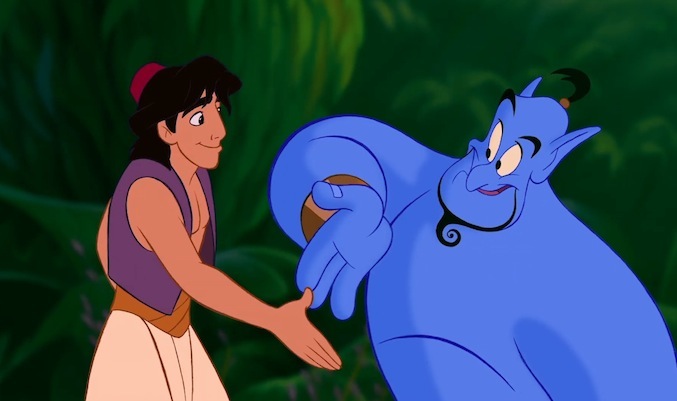
We use the indicative mood most of the time. This verb mood is good for stating facts, making requests, or asking questions. Aladdin uses this mood when he says, “Genie, I wish for you to make me a prince.” The verb in this sentence is wish. This is a simple request, and Genie is happy to lend a hand:

Disney's Aladdin and Genie shaking hands

You’ve got a deal!

Imperative Mood

We use the imperative mood for commands. Our story’s villain, Jafar, is fond of using the imperative mood. After he steals the lamp, he commands: “Genie, grant me my first wish.” Here, the verb is grant. Jafar could have said, “I would like you to grant me my first wish,” which would have been more polite (and indicative). But no. And guess what happens when you use the imperative mood on a genie?

Genie cheering for Jafar in Aladdin

Can you tell I’m motivated?

Subjunctive Mood

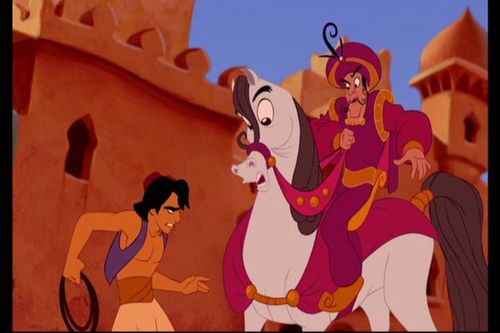
This final verb mood is the trickiest. We use the subjunctive mood for unlikely possibilities, things that are not true, and (you guessed it) wishes. You often find the subjunctive mood hanging around with the word if. Aladdin uses the subjunctive when he protects children from being whipped by a rude prince. He says, “Hey, if I were as rich as you, I could afford some manners!”

We can tell this is the subjunctive mood because Aladdin says I were. This can sound strange to our ears, because normally people say I was. With the subjunctive, however, the verb form were is always used (if I were, if you were, if he were, if she were…).

So why is this verb mood important? It tells us that Aladdin thinks he will never be rich. After all, he doesn’t have a genie to help him with that…yet.

Disney's Aladdin on manners of the rich

If only I had a genie…

Once Aladdin finds Genie, he never uses the subjunctive mood again. Why? Because he knows that his wishes will come true. They are no longer unlikely to happen. So, unlike the rest of us, he doesn’t need to think about when to use the subjunctive mood.

After talking about this, now I really want a genie. I’m sure it would improve my mood. Imagine the possibilities…

When universes collide

Have you ever suffered through a one-sided conversation? Maybe you have nothing in common with the other person, and you find the topic dead boring. Or maybe your conversation partner is an “expert” on everything, and is lecturing you about what you should do. This is sheer torture, you think. When can I make my escape?

Consider yourself lucky. You could be listening to Vogon poetry.

The Hitchhiker’s Guide to the Galaxy tells us that Vogon poetry is the third worst in the universe. (Earth poetry is the worst, of course.) The Vogons know how much everyone hates their poems, but they force people to listen to them out of “sheer bloodymindedness.” Just witness what happens at a friendly Vogon poetry reading:

The sweat stood out cold on Ford Prefect’s brow, and slid round the electrodes attached to his temples. These were attached to a battery of electronic equipment—imagery intensifiers, rhythmic modulators, alliterative residulators and simile dumpers—all designed to heighten his experience of the poem and make sure that not a nuance of the poet’s thought was lost.

– Douglas Adams, The Hitchhiker’s Guide to the Galaxy

Let’s face it, we all have an inner Vogon. We can get so caught up in what we think is important that we ignore what everyone else thinks. We keep on talking or writing, hoping that the sheer volume of our words will convince others of our rightness.

If you truly want to get your message across, remember that you are not the centre of the universe.  Everyone sees things from a unique point of view. You need to connect with others, not collide with them. Here’s some ways you can do this:

  • Address the “So what?” factor. This is also known as WIIFM or “What’s in it for me?” Why should people care about what you have to say? How will it benefit them? You may think the inner workings of the Infinite Improbability Drive are fascinating, but that doesn’t mean they will. Focus on the “So what?” and your message will be more successful.
  • Show some respect. Respect your conversation partner’s time by keeping your message short. Respect that person’s intellect by listening to what he or she has to say. In any conversation, try to spend more time listening than talking. You’ll be amazed at what you discover.
  • Speak in their language. Don’t use uncommon words or jargon that a lot of people don’t know. Your audience shouldn’t need a Babel fish to understand what you are saying.  If you need to use an unusual term to get your message across, then smoothly define it and move on.

And if you find yourself stuck listening to that annoying person? Just remember what The Hitchhiker’s Guide tells us in “large friendly letters” on the cover:

Picture by Jim Linwood. Source: Wikimedia Commons.CC-BY-2.0

Picture by Jim Linwood. Source: Wikimedia Commons.CC-BY-2.0

It will be over soon. Then you can go back to enjoying your universe.

Slay those villainous pronouns!

Epic fantasy books often have a huge cast of characters. A Game of Thrones by George R.R. Martin has over two hundred of them. I love this novel, but keeping track of everyone can be hard on the brain!

Game of Thrones, Season 3

No, him! That guy! The one with the…oh, never mind.

Luckily, Martin does a fantastic job writing about his characters. (This is why his book has turned into a popular HBO series.)

Even with a smaller number of characters, it can be tough to figure out who’s doing what. This is because writers tend to rely too much on pronouns.

Those Sneaky Pronouns

When you write a lot about the same people, you can get tired of repeating names all the time. This is why you use personal pronouns—like he, she, or they—to take the place of the names. It’s okay to do this, as long as your readers know who the pronoun is replacing (the antecedent of the pronoun). Unfortunately, your readers may not be able to tell.  They’ve fallen into the ambiguous antecedent trap!

Two Sentences, Three Ways

I’m going to take a passage from A Game of Thrones to show you what I mean by troublesome pronouns. Here’s the original text:

“Will could see the tightness around Gared’s mouth, the barely suppressed anger in his eyes under the thick black hood of his cloak. Gared had spent forty years in the Night Watch, man and boy, and he was not accustomed to being made light of.”

After reading this passage, we know something about Gared and his history. The meaning is clear. But what if I replace one name with a pronoun?

“Will could see the tightness around Gared’s mouth, the barely suppressed anger in his eyes under the thick black hood of his cloak. He had spent forty years in the Night Watch, man and boy, and he was not accustomed to being made light of.”

Now we have to think. Is “he” referring to Will, or to Gared? We might guess it’s Will because Will is the subject of the first sentence. Eventually, we figure out that it’s grumpy Gared. Meanwhile, we’re grumpy that we had to think about this.

What happens if I replace another name? Uh oh.

“Will could see the tightness around his mouth, the barely suppressed anger in his eyes under the thick black hood of his cloak. He had spent forty years in the Night Watch, man and boy, and he was not accustomed to being made light of.”

Now we have no idea what’s happening. Is Will looking at his reflection? There’s nothing that tells us otherwise. We’ve lost track of Gared altogether.

See what I mean about the dangers of pronouns?

A Call to Arms

The best way to avoid this trap is to pay attention to those sneaky pronouns. Are you sure that your reader is going to know your meaning when you use one? If not, you can try one of these tactics:

  • Get rid of that pronoun and replace it with the noun. Sometimes this works. Sometimes it can make your sentences feel repetitive. You be the judge.
  • Change the order of your words so that the pronoun is closer to the original noun (the antecedent). This makes it easier to tell that the two words are related to each other.
  • Reword your sentence so that you don’t have to use a pronoun. Who needs them, anyway?

Don’t let your readers be ambushed by pronouns. It’s time to fight back!

(P.S. Here’s a bonus link about ebook typos for Game of Thrones fans. Enjoy!)

Excuse me while I freeze

Oh, the joy of public speaking. You get to stand up in front of your peers as they stare at you blankly. (You just know they are thinking about when this will be over, so they can go grab lunch.) You persevere regardless, until suddenly you forget what you were going to say. The silence stretches.

If only you had a good excuse, you think. Maybe a Death Eater has cast a petrificus totalus spell on me. Or I’ve been transported to that episode of Buffy where nobody could speak. (At least then your audience would be suffering along with you.)

But no, it’s only stage fright. How humiliating.

Best episode of Buffy, ever. Except maybe the musical episode.

Good question.

I used to really hate being in front of an audience. I took drama classes in high school to get over it. Trust me, after you’ve squawked like a chicken as part of a class exercise, nothing is embarrassing anymore.

If you’re like me, it will never be easy for you to speak in front of people. But you can definitely master it, and even be known for your fantastic presentations. Here’s some suggestions on how to get there:

  • Rehearse. When a witch mixes up the words of her spell, she can accidentally summon a demon. (Oops!) You’re lucky—all you have to worry about is sounding like you know what you’re talking about. Grab an empty room and present to the wall. The first time you talk through it, you are going to feel like an idiot. Do it again and you’ll start to figure out what you want to say. By the third time, you’ll sound like a natural.
  • Take your time. Pretend you are speaking in slow motion. This will help you go from too fast to just right. You will look and sound relaxed. This will fool your body into thinking it’s relaxed, too. As a bonus, your audience will easily understand what you are saying.
  • Use the silence. Got stuck somewhere? No problem. Use this time to drink from a glass of water and casually glance at your notes. Don’t feel the need to add any fillers, like “um….” People like a good pause—it gives them time to digest your words. If you’re still struggling, then ask your audience a question. (“What do you think?” “Any questions so far?” “Did anyone else see that demon over there?”) By the time someone else finishes speaking, your brain will be back on track.

I’ve had people tell me, “You made it seem so effortless when you were up there. I could never do that!” The secret is that it’s not effortless. You need to do your prep work. Then you’ll be the one casting a spell on your audience.

Go short

What’s your favourite line from a movie you love?

One of my favourite lines is from The Matrix, a movie that has generated many famous catchphrases.  There are posters all over the net asking us to choose between the red pill or the blue pill.  Fans debate the meaning of “There is no spoon.” For me, however, the best line comes when Trinity does a cool move and takes out an Agent: Dodge this.

This is a brilliant visual scene, with great angles and use of “bullet time” camera techniques. But the line itself is equally important. Why is this such a memorable line? I could answer this by talking about character, or plot, or scene context. But here’s an even better reason: it’s short.

Think about your favourite movie line. Is it short, too? Chances are it is. Otherwise you probably wouldn’t remember it.

When we communicate with others, we can choose from different styles. We can weave and dodge and come up with fancy words and meandering sentences. Or we can go for it and cut straight to the chase. Which style do you prefer to listen to? (Yes, this is a trick question.)

Here’s my first tip on communication: Go short.  Use short sentences with short words. This is the best way to truly connect with your audience.

You might think that going long will make you sound impressive. Unfortunately, you will likely end up distancing yourself from others. The human brain is constantly bombarded by information, and we don’t have the energy to sift through it all. It’s difficult for us to remember anything, let alone long and wordy sentences. And what’s the point of communicating if what you say won’t be remembered?

Many people find it’s hard to go short. If you cut your teeth writing essays in university (like I did), you may find it especially difficult. After years of trying to get great marks by using long phrases, suddenly you need to shift to a new way of thinking. So how can you do it? Here’s a few tips to get you started:

  • Make sure each sentence contains only one idea. Every time you start to add on another idea, begin a new sentence.
  • Aim for sentences of twenty words or less. This doesn’t mean all of your sentences need to be this short—it’s good to break things up with a long sentence once in a while. Just keep in mind that twenty words is the general limit for most audiences. (Academics tend to be an exception, since they are dealing with complex ideas.)
  • Watch out for connecting words, otherwise known as conjunctions. These words connect ideas together, and are fabulous tools. But connected ideas don’t always have to be in the same sentence. Despite what your English teacher may have told you, it is okay to start a sentence with a conjunction, like “and.” Or “but.” Or “or.” So feel free to break those ideas apart into separate sentences.

If you go short, you’re well on your way to communicating something memorable. Maybe you will even come up with the next catchphrase. And if you’re still not convinced that short is the new black, just think about the scene from The Empire Strikes Back when Han Solo is about to be frozen in carbonite:

shirt1980

Leia: I love you.

Han: I know.

Five words. Basic character truths. What more could you ask for?