Interview with Brendan O’Brien, Editor and Writer

Today I’d like to share my interview with Brendan O’Brien, originally posted on the blog The Editors’ Weekly. Brendan lives in County Cavan, Ireland, and has over 26 years of experience as a writer and editor. He will be speaking at Editing Goes Global, the first international conference for editors.

(The conference is being held in Toronto, Canada in June – so those of you who are writers or editors and are in the general area may want to check it out.)

In other news, wallcat from My Inner Geek wrote a great follow-up to my Black Widow post from last week. It’s been wonderful to see all the lively and respectful discussion around the topic of female characters.

Finally, my apologies for being late in replying to comments last week. I’ve been down with a pesky virus but am now recovering. I should be back to my usual schedule with an original post for next week. 🙂


Cheers,

Sue


© Sue Archer and Doorway Between Worlds, 2015

The Erasure of Black Widow: Do We Need to Write Female Characters Differently?

Age of Ultron Black WidowI saw the movie Avengers: Age of Ultron last week. I had been looking forward to watching this movie for a long time, so I did my utmost to avoid encountering any spoilers. I enjoyed it, though I felt that parts of it were uneven and that it didn’t come together as well as the first Avengers movie.

Once I’d seen the movie, I checked out what other people had thought of it. That’s when I discovered the complaints about the character development of Black Widow.

I realized that the movie I saw was not the same movie that others had seen.

*character spoilers ahead*

What Some People Saw

A betrayal of Black Widow’s character through

– making her “the girlfriend”

– making her a damsel in distress

– making her a mother figure

– making her feel monstrous for not being able to have children.

What I Saw

An evolution of Black Widow’s character, as shown through

– her attempt to develop a romantic relationship

– her demonstrated ability to protect her other team members and fulfill critical missions (without super powers)

– her yearning for family and connections

– her acknowledgement that she feels monstrous due to her training as an assassin.


What happened here? How could these interpretations be so different?

I certainly don’t think that the portrayal of Black Widow’s character was perfect. I’ve complained before about the lack of strong female characters in action movies, and this movie doesn’t break any new ground on this issue. Outside of the movie itself, Marvel is not impressing me with their failure to produce Black Widow action figures. They have even erased her from her own key movie scene.

But still. I didn’t pick up on all the negative nuances that others found in this movie.

This leads me to the question of how to treat female characters in a male-dominated genre. Should writers be treating female characters differently from male ones? And how should gender issues be addressed?

Female Characters as Human Beings

I’d like to think that all characters are simply human beings. When Black Widow needed to be rescued in the film, I didn’t see her as a damsel in distress that needed to be saved by a boyfriend. I saw her as a valuable team member that needed to be rescued by another member of the team, just as the Avengers would do for any team member. The fact that she was female and in a relationship just didn’t make any difference to me.

But I can see why others found this disturbing. We’re constantly surrounded by stories that portray women as the girlfriend, the damsel in distress, the mother figure…so we understandably get twitchy when we keep running into these tropes.

In reading up on this issue, I came across a fantastic article by Kate Elliott (one of my favourite fantasy authors) called Writing Women Characters as Human Beings. She shares three key pieces of advice, which I am paraphrasing here.

1. Have enough women in the story that they can talk to each other.

In this respect, Age of Ultron fails the grade. Although there are multiple female characters, they don’t have meaningful moments with each other. I can’t even remember if Scarlet Witch and Black Widow ever talked to each other.

2. Pay attention to how you are assigning minor roles.

In many stories, the tertiary-level characters are played by men. Age of Ultron does include several female characters in minor roles, including Dr. Cho, Laura, and Madame B.

3. Your female characters should exist for themselves, and have their own agency in the plot of the story.

I would say that Scarlet Witch is the female character that has the most agency in this movie. Her decisions and actions drive many of the key plot points. Black Widow has less agency in the plot, but I would argue that she does have her own dreams and desires that she acts upon in the movie. It’s just that those desires do not line up with the idea of a “kick butt” female action hero. Is that wrong? Maybe not. But in the context of male-dominated superhero action movies, it clearly doesn’t work for a large segment of the audience.

***

Have you seen Age of Ultron? How did you feel female characters were portrayed in the movie? Do you think female characters need to be treated any differently than male ones?


© Sue Archer and Doorway Between Worlds, 2015

Reflections on the A to Z Blogging Challenge

Now that I’ve had the weekend to recover, I thought I’d post my reflections on the April A to Z Blogging Challenge. This was my first time taking the challenge, and I learned a lot from the experience.

A to Z Reflections

Prepare, Prepare, Prepare

I’m glad I prepared most of my posts ahead of time. As someone who normally blogs once a week, I don’t know how I would have survived writing a post every day. And if I had managed it, I definitely wouldn’t have had much time to visit other bloggers. Even with all my preparation, I found that I couldn’t do everything I wanted. I’m a firm believer in responding to all of my commenters (and I am certainly thankful for all the comments I received!), but this left me with limited time to read other posts. For those of you who wondered where I went to, I am now catching up!

If I do this again next year, I will be sure to write all of my posts ahead of time.

Have a Meaningful Theme

I’m thankful that most of my posts were based on suggestions from my readers. This kept me motivated to write my posts, since I knew at least one of my readers would be interested in the rogue word of the day. It also helped me to channel my imagination and come up with defined ideas because I was starting from a specific word prompt. For anyone interested in taking up this challenge for next year, I recommend having some kind of theme.

Find a Better Cross-Blog Platform Tool

The most troublesome aspect of this challenge was trying to interact with bloggers on other blogging platforms. I found myself getting annoyed by CAPTCHA because I kept having to prove I wasn’t a robot. Then when I left a comment, there was no easy way to find out the response to it, short of coming back to the post or asking to be notified via email. I’m sorry, but my email is full as it is. So I feel I missed out on some chatting with non-WordPress bloggers. If someone else has a suggestion on how to manage this interactivity issue, I’d be happy to hear it!

Make New Blogging Friends and Learn a Lot

The best thing about doing this challenge (other than the personal sense of accomplishment) was getting to meet some great new bloggers and read their posts. I was amazed by the variety of topics and the amount of effort my fellow bloggers put in to their posts.

During April, I visited all sorts of wonderful places. I experienced life in Japan and found out how to interpret kanji characters. I toured through Glasgow and New Zealand. And I learned about the experiences of women living in India.

I also went back in time to celebrate the Roaring Twenties in America and to salute the bravery of those who lived through World War II.

I read lots of fiction as well, including an ongoing mystery story, flash fiction using odd words, creative stories from childhood, and a series of stories inspired by types of trees.

I got my sci-fi/fantasy fix, too, by reading philosophical discussions about science fiction, discovering comic book characters, and assessing the merits of sword and sorcery movies.

I even found a fabulous blog series that is chock-full of useful writing tips.

I could go on and on…but then the word count of this post would really push the limit!

Congratulations to all of you who made it through A to Z. And thank you to everyone who helped make this a positive experience for me: host Arlee Bird and his many helpers (especially John Holton, who helped me on my way), my fellow A to Z bloggers, and all my readers and commenters.

And to my son, who inspired me and who drew this wonderful tribute to the challenge.

Alphabet

Until the next challenge,

Sue


We will now return to Sue’s regular posting program…see you all next week!


© Sue Archer and Doorway Between Worlds, 2015

Rogue Words from A to Z: Zeroing In on Zombies

A to Z Letter ZThis is the final post in this month’s Rogue Words series. I’ve had a lot of fun doing these, and I’m sorry to see them go. In fact, I’m thinking about making them a regular feature of my blog. If you have an opinion on whether you’d like me to round up more rogue words in the future, please feel free to leave a comment!

And now, on to today’s word…the deceptively simple-looking zero.

Zero can be used as an adjective, a verb, or a noun.

Zero As an Adjective

When zero is used as an adjective (which is rare), the noun it describes must be plural (or be a non-countable noun, like awareness).

Zachary charged through the door of Professor Z’s office, dragging a girl with him. “Something’s really wrong with Zoe, Professor! I had zero ideas about what to do, so I brought her to you. Can you help?”

Zoe stood where Zachary had left her, in front of Professor Z’s desk. Her hair was scraggly and her face had a grey tinge. She stared at the Professor blankly. It was clear that she had zero awareness of what was going on.

Zero As a Verb

When zero is used as a verb, you sometimes (but not always) need to add an e. Forms of the verb zero include zero, zeroes, zeroed, and zeroing.

“Hmmm,” said Professor Z in her reassuring way. She walked around Zoe, studying her from all angles. Zoe didn’t react at all, even when the Professor poked her in the arm.

“I said to myself, Professor Z is someone who always zeroes in on the problem,” said Zachary. He bounced from foot to foot. “I’ve been thinking…do you think Zoe’s turning into a zombie? That would be so zany, but I’m not sure what else to think!”

“Do you see this?” the Professor asked Zachary. She pointed at Zoe’s watch. Zachary bent to look.

Zero As a Noun

When zero is used a third-person verb, you write it as zeroes. But when zero is used as a plural noun, you don’t use an e: it’s spelled zeros.

The watch was set on a timer, and it was counting down to zero. Only five seconds to go…

“Oh no! In five…no, four seconds, she’s going to turn into a zombie! I knew it!”

“I don’t think so,” said Professor Z.

The time counted down until there were only zeros: 00:00:00. The watch started beeping.

 Zoe stirred and blinked. “It’s done? I’m all finished?”

“Yes, dear,” said the Professor gently. You can go to bed now.” Zoe shuffled out of the room.

Zachary stared after her. “What was that about?”

“Just as I suspected,” said the Professor. “It’s now May first. The A to Z Blogging Challenge is over, and Zoe can finally get some sleep.”

***

Congratulations to everyone who made it through the A to Z Challenge! Thanks so much for reading, liking, and commenting on my posts. 🙂

For those who are new to my blog, I hope you will continue to visit after A to Z. I will be posting my A to Z Reflections post next Monday, and then will go back to my usual weekly posting schedule. I post a mix of creative writing and grammar tips, interviews with others about communication (Conversation Corner), and in-depth reviews of writing resources (DBW Reviews).

See you on the other side! Off now to get some sleep…


© Sue Archer and Doorway Between Worlds, 2015
Rogue Words from A to Z: You’re Not a Yutz

A to Z Letter YDo you feel like a yutz when you have to decide between using your or you’re?

You’re not alone.

There’s a good reason why we struggle with when to use you’re. This word violates all our expectations.

Normally an apostrophe is used to show that someone possesses something, as in “Sue’s yo-yo.”

But if you want to write “your yo-yo,” you need to use the word your without an apostrophe.

You’re with an apostrophe is only used when “you are” is being contracted into one word.

The same rule applies to their / they’re and its / it’s. If you’d like more on these words, you may want to check out my grammar story Night of the Apostrophe Ninja.

To demonstrate this apostrophe rule, here’s a very short story.

Your vs. You’re – Who Will Win the Lady’s Heart?

In days of yore, two knights stood before the Queen, yammering about their quest to slay the yellow yeti.

Your Majesty,” said the older knight, “I regret to report that we were unable to fulfill your desire. The beast is still alive.”

“What beast?” asked the Queen, bewildered.

We?” protested the younger knight. “You’re the one who decided it was a good idea to wake the yeti up by challenging it, instead of sneaking up and chopping off its head.”

The Queen flinched. Then her cheeks blossomed in anger. “How dare you-”

“Look how you have offended Her Majesty by your violation of the Knight’s Code of Conduct!” remonstrated the older knight. “You have constantly demonstrated your ignorance of our traditions.” He turned to the Queen, who was clearly in a rage. “Your Majesty, I protest. Your young ‘champion’ is hotheaded and will not listen to reason.”

“Listen to reason? You’re the one who never listens! You’re too busy living in the past, and now we’re stuck with that yeti.”

You’re the ones who are not listening,” yelled the Queen. “How dare you interrupt me!”

The two knights were immediately silent.

“We gave no command to attack the yellow yeti. Clearly you have been blinded by your pride. We hereby strip you of your titles until you’re willing to act like the knights you should be.”

The former knights slunk away, shamefaced.

After they had left the chamber, the Queen’s form shimmered, and in her place was a yellow yeti.

“Well, that was close,” said the yeti. “Good thing my knights are a bunch of incompetent yahoos, or I would never have heard the end of it from my sisters.”

***

I can’t believe I’m coming up to the last A to Z post! Stay tuned for the final episode tomorrow, where I will zap the zombified letter Z…


© Sue Archer and Doorway Between Worlds, 2015

Rogue Words From A to Z: X-Ray Vision Won’t Help You Now

A to Z Letter XX-ray is an exasperating word because there is a lot of disagreement over how to spell it. Should it have a hyphen? Should the X be capitalized? Is it X-ray, x-ray, X ray, or x ray? All of these variations have been used.

Some people will tell you that X-ray should be hyphenated when it’s used as an adjective (as in X-ray vision or x-ray vision) and not hyphenated when it’s a noun (as in getting an X ray or an x ray). Sounds complicated. No wonder people are confused!

My advice to you is to follow the generally accepted style rule for words that have a letter as a prefix: Capitalize the letter and hyphenate the word (X-ray). You can’t go wrong with this, because it’s consistent with other words in this category (T-shirt). It’s also described as the most common style in Garner’s Modern American Usage.

Crookes X-ray tube

And now…as I’m sure you have come to expect, I have written you a story to help illustrate this rule. And since we’ve been talking about X-ray vision…

Extra-Special Man was doing his usual flyby over the city when his extra-sensitive hearing caught the sound of maniacal laughter somewhere behind him.

That sounds like someone who is about to execute an evil plan, he thought, and did a U-turn in the air. As he neared the extra-large building that was the source of the sound, he used his X-ray vision to examine the top floor.

He spotted a large shape that was radiating the energy of an A-bomb. Alarmed, he crashed through the nearest window, only to be blinded by the sight of a man with an electric blue mustache wearing a neon pink-and-yellow striped suit and a lime green top hat.

“I should have known it was you, Fashion Nightmare,” said Extra-Special Man. “What exasperating action are you up to this time?”

“Ah, Extra-Special Man! I am happy that an A-list superhero has come to witness my exciting triumph. I have finally completed my V-gun, and it is time to unleash it on this city.”

“A V-gun?” asked Extra-Special Man. “What does it do, exactly?”

“I’m glad you asked. After I press this extra-small button, the entire city will be wearing one of these!” He brandished a scratchy woolen V-neck sweater with a garish picture of a purple moose on it. “It’s my own exclusive design,” he said proudly.

“You can’t force the people of this city to wear that ugly sweater. That would be un-American.”

“This coming from someone who wears tights? And why do you care?” asked Fashion Nightmare. “After all, you’re an alien from Xenon.”

“Well, that was rather xenophobic of you,” said Extra-Special Man, miffed.

“Besides, you’re too late,” said Fashion Nightmare, and pressed the extra-small button.

The V-gun sputtered and exploded, enveloping Fashion Nightmare in a haze of yellow light. When it cleared, Fashion Nightmare’s clothing looked somewhat different.

“A white T-shirt and blue jeans!” he exclaimed in horror. “How exceedingly banal! I can’t possibly wear this!” He tried to rip the shirt off, but it wouldn’t budge. “Someone get this off of me!” He started whimpering.

“Well, I hope you learned your lesson,” said Extra-Special Man. “Exulting in the extreme exercising of evil deeds only leads to execrable results.” He paused. “And there’s nothing wrong with my tights!”

***

Image of the Crookes X-ray tube from Wikimedia Commons

This post is dedicated to my copy editing instructor, who taught me how to deal with the complexities of hyphens.

Stay tuned for tomorrow’s post, where I will yell about the yellow-bellied letter Y…


© Sue Archer and Doorway Between Worlds, 2015
Rogue Words from A to Z: If Wishes Were Wanting…

A to Z Letter WOne of my readers suggested that I write about when to use were with a singular subject (heard in the classic song from Fiddler on the Roof: “If I were a rich man…”). Why don’t we sing, “If I was a rich man?”

The short answer: “If I were a rich man” is written in the subjunctive verb mood. What on earth is that? I wrote the long answer to that question many moons ago, when I first started blogging. Hardly any of my readers have seen that post, since it’s back from the times when my readers were mostly crickets.

So I figured it was time to bring this out again and answer my reader’s question. I hope you enjoy it!

If Wishes Had Genies…

Verbs have moods, just like genies do. And we all know you need to pay attention to someone’s mood if you want to get your wish. (“Can I have a cookie, Mom? Pleeease?” Oh, no, it’s not working! Time for the cute face. “I love you.”)

Disney’s Aladdin shows us all about moods and how we can stay on the good side of verbs. The film’s characters use the three verb moods: indicative, imperative, and subjunctive. Let’s see how each mood can affect your chances of getting your wish.

Indicative Mood

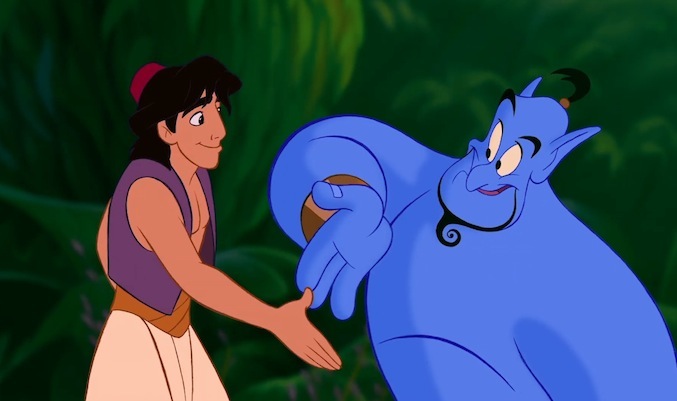
We use the indicative mood most of the time. This verb mood is good for stating facts, making requests, or asking questions. Aladdin uses this mood when he says, “Genie, I wish for you to make me a prince.” The verb in this sentence is wish. This is a simple request, and Genie is happy to lend a hand:

Disney's Aladdin and Genie shaking hands

You’ve got a deal!

Imperative Mood

We use the imperative mood for commands. Our story’s villain, Jafar, is fond of using the imperative mood. After he steals the lamp, he commands: “Genie, grant me my first wish.” Here, the verb is grant. Jafar could have said, “I would like you to grant me my first wish,” which would have been more polite (and indicative). But no. And guess what happens when you use the imperative mood on a genie?

Genie cheering for Jafar in Aladdin

Can you tell I’m motivated?

Subjunctive Mood

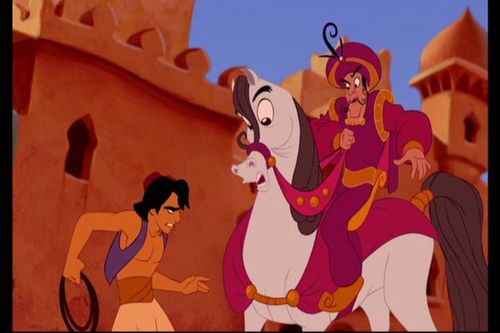
This final verb mood is the trickiest. We use the subjunctive mood for unlikely possibilities, things that are not true, and (you guessed it) wishes. You often find the subjunctive mood hanging around with the word if. Aladdin uses the subjunctive when he protects children from being whipped by a rude prince. He says, “Hey, if I were as rich as you, I could afford some manners!”

We can tell this is the subjunctive mood because Aladdin says I were. This can sound strange to our ears, because normally people say I was. With the subjunctive, however, the verb form were is always used (if I were, if you were, if he were, if she were…).

So why is this verb mood important? It tells us that Aladdin thinks he will never be rich. After all, he doesn’t have a genie to help him with that…yet.

Disney's Aladdin on manners of the rich

If only I had a genie…

Once Aladdin finds Genie, he never uses the subjunctive mood again. Why? Because he knows that his wishes will come true. They are no longer unlikely to happen. So, unlike the rest of us, he doesn’t need to think about when to use the subjunctive mood.

After talking about this, now I really want a genie. I’m sure it would improve my mood. Imagine the possibilities…

***

Images from Disney’s Aladdin

This post is dedicated to my loyal readers from the beginning blog times who are still with me. I hope you enjoyed this blast from the past!

Stay tuned for tomorrow’s (new) post, where I will eXamine the xenophobic letter X…