Rogue Words from A to Z: A History of Homely Hauntings

A to Z Letter HIs that decrepit old haunted house historical or historic? Or neither?

The word historical means “of or relating to or occurring in history.” Historical refers to something that happened in the past.

Josephine looked around in interest as she followed the tour guide through the creepy old manor. She stopped in front of a painted portrait of a young, dark-haired woman with a protruding nose and sharp black eyes.

“Who is this?” she asked the guide. “She looks rather homely.”

Historical evidence indicates that this is the daughter of the original owner,” said the guide. “She tragically went missing one night, and no one ever saw her again.”

The word historic, on the other hand, means “historically significant” — a momentous happening or development. An event can be historical without being historic. Only important events are historic.

“I’m surprised I never heard about her,” said Josephine.

The guide raised her eyebrows. “Her disappearance was quite a historic event in these parts.”

“Well, it can’t have been that historic if no one talks about it any more,” pointed out Josephine.

The guide sniffed her disdain at this pronouncement.

(Side note: An event is a historic event, not an historic event. The h in historic should be treated like any other consonant.)

The Haunted House / Das GeisterhausSo is this old building historic, or historical? It’s neither. A house that still exists is in the present, not the past. But the house could be of historical interest to those who study history.

“Well, really,” said Josephine, annoyed, “if this house is of such historical interest, they should do a better job of advertising it. And make it more homey for visitors,” she said, eyeing the cobwebs in the corners.

“Some people say that the house is haunted by the spirit of the missing woman,” said the guide, glaring, “and that bad luck will come to those who bring negative energy with them.”

“Well, that was subtle,” said Josephine. “I have better ways to spend my time than being insulted. I’m leaving.” She stalked off down the hall. The guide shut the light off and trailed behind her, thankful that this was her last tour of the day.

In the gloom, the eyes of the portrait followed them.

Bonus Word: Homely

The word homey means “homelike.” Homely originally shared this meaning, but this has changed over time. In British English, homely means simple or unpretentious. But in American English, it means unattractive or plain. I’ll leave you to decide whether the woman in the portrait was insulted!

Do you have any good haunted house stories that you’d like to share? 🙂

***

This post is dedicated to Jaso.

Image of Haunted House by Harald Hoyer, from Wikimedia Commons

Definitions and usage information were sourced from Garner’s Modern American Usage. Thanks for reading!

Stay tuned for tomorrow’s post, where I will immobilize the intractable letter I…


© Sue Archer and Doorway Between Worlds, 2015

Rogue Words from A to Z: You May Be Good, But I’m the Goodest

A to Z Letter GGood seems like a nice, simple word at first glance. Most of the time our use of good is good enough. But if we want to use it perfectly well, we need to know how good is different from the word well.

Well can be used as either an adjective (describing a noun/pronoun) or an adverb (describing a verb/adjective). When we say “I feel well,” well is describing the pronoun I. When we say “She did well,” well is describing the verb did. So far, so good. 🙂

Good, on the other hand, is only supposed to be used as an adjective. You can say, “I feel good,” (nah-nah-nah-nah-nah-nah-nah!) but not “She did good.”

To complicate matters, we’ve developed some “acceptable” sayings in English that do use good as an adverb. An example of this is “a good many more.” Why these exceptions? I have no idea.

At least we can agree that there is no such word as goodest. (Even though that would actually make sense. Who decided best was the way to go?)

To show some of the many ways good is used, here is a short story. I’ve put an next to any incorrect usages, so you can spot them in your own writing.

You May Be Good, But I’m The Goodest X

Gareth was dining alone at his usual table in the Gargoyle Monster Hunters Club when that blasted braggart Stuffington came in.

Good day, old chap,” said Stuffington. “You don’t mind if I sit here, do you?” He casually slid into the chair across from Gareth.

Gareth ignored him and sipped his Earl Grey tea while studiously reading the paper. Hmm. More rumours of ghost sightings in the slums.

Undeterred, Stuffington announced, “I suppose you’ve heard about my good deed for the day. I’m feeling quite good about it, naturally. Always happy to do my part.”

“I’m sure you are,” muttered Gareth behind the pages.

“It’s not every day you get to take on a gaggle of galumphing golems. There were a good many more of them than I was expecting, but I did them but good. The good people of our city won’t be bothered by them again. They are gone for good.”

“And yet, you’re still here,” said Gareth darkly. He gave up and folded down his paper, glaring at Stuffington.

“Oh, don’t be jealous, old boy. You did good taking down those ghouls in that gallery, even if one of them did get away.  It’s not your fault you’re not as good as I am. You’ll get there when you’re good and ready. You should really read my monster-hunting manual, it would do you good. Pick up some tips.”

“You know, I’m really not feeling well,” said Gareth, getting up from the table. “I’ll see you another time, Stuffington.”

“Oh, let me drive you home. I insist.” Stuffington trailed after him, talking about how the engine of his new motorcar ran so good  that he always made it everywhere in good time.

Gareth felt a prickling at the back of his neck as they left the club. He instinctively ducked sideways as a giant flapping noise came from behind him. He could feel the whoosh of air going over him as a man shrieked.

He looked up and saw Stuffington being carried away by an enormous grey gargoyle.

Goodbye,” said Gareth, not without some satisfaction.

Paisley Abbey New Gargoyles

I love these gargoyles from Paisley Abbey!


Bonus Word: Galumph

To galumph means either to move noisily and clumsily or to go prancing in triumph. The second meaning was coined by Lewis Carroll in his fabulously fun poem Jabberwocky.

***

Gargoyle picture © User:Colin / Wikimedia CommonsCC-BY-SA-3.0

Definitions were supplied by the Canadian Oxford Dictionary.

This post is dedicated to Lori MacLaughlin and Shawn. Thanks for reading!

Stay tuned for tomorrow’s post, where I will hilariously hunt down the horrible letter H…


© Sue Archer and Doorway Between Worlds, 2015

Rogue Words from A to Z: Furthering Femininity in Fantasy

A to Z Letter FWho here gets irritated at how women are drawn on fantasy book covers?

It’s better than it used to be, but I still run across ridiculous illustrations of supposed swordswomen who would be killed in their first fight because their armour doesn’t cover all their vulnerable parts.

I’d like to use this terrible state of affairs to help explain when you should use farther vs. further.

Farther is used to describe actual physical distances.

Further is used to describe figurative distances.

To show the difference, let’s imagine a one-sided conversation between an illustrated woman and her book cover artist.

Woman: You know I can run farther in these impractical high-heeled boots than you ever could in your sensible footwear. Not that I want to. Seriously, who wears these things?

Artist: Hears nothing. Too busy focusing on the book details. Hmm, maybe the heels aren’t high enough…

Woman: If you push this any further, I’ll be forced to kick you where it hurts. Then you’ll be sorry for giving me these boots.

Artist: Looks up and frowns. After a brief pause, shakes his head irritably, then gets back to work.

Woman: You’re not good at listening, are you. Didn’t you read the book blurb? We’re travelling farther than anyone else has ever journeyed before, through freezing wastelands and frost giant-infested mountains. What possessed you to give me a skimpy top that I wouldn’t be caught dead in? And I will be dead if I wear that. I wouldn’t last through the night, let alone through my first fight!

Artist: Examines the drawing closely. Exclaims in triumph and starts adding a necklace that dangles between her bare cleavage.

Woman: You have a lot further to go in your understanding of women, pal. The modern definition of femininity includes practical clothing and jewelry that won’t strangle me while I’m kicking butt. So put a coat on me already. Or I quit!

Artist: Starts wondering if the cleavage is big enough. Maybe a skimpy vest to help emphasize those curves?

Woman: That’s it, I’m out. I’ll be somewhere far, far away. So don’t come looking for me.

Artist: Blinks at a suddenly empty page. Closes his eyes, then looks again. Maybe not quite an empty page. In tiny letters scrawled at the bottom of the page, he sees a message: These boots are made for walking…

Bonus Word: Femininity

One of my readers has noted that femininity is difficult to spell, and that it’s easy to write feminity. An interesting tidbit you may not know: Back in the fourteenth century, both of these spellings were used. Over time, femininity has become the standard. Probably because it matches the number of syllables in the corresponding word masculinity.

So if you accidentally spell feminity, you can take comfort in the idea that you are right, but have the bad luck to be living in the wrong century. 🙂

***

Note: This post has a North American slant. In British English, further is often used for both meanings.

This post is dedicated to Lori MacLaughlin and Ameena.

Definitions are from Garner’s Modern American Usage.

Thanks for reading! Stay tuned for tomorrow’s post, where I will grapple with the ghastly letter G…


© Sue Archer and Doorway Between Worlds, 2015
Rogue Words from A to Z: Endeavouring to Push the Envelope

A to Z Letter ESpecial delivery! Here comes another rogue word for us to rip apart: envelope.

The word envelope is derived from the French word enveloppe (from envelopper, which means to envelop).

There are a number of difficulties in spelling this tricky word. Native French speakers often struggle with envelope in English because it has one p rather than two. But even native English speakers can have trouble: namely, understanding when to use envelope and when to use envelop.

Envelope (with an e, pronounced Ehn-vuh-LOPE or Ahn-vuh-LOPE) is a noun meaning a wrapper or enclosure. When applied to aircraft or other technology, it means a set of accepted performance limits. This is where we get the phrase “pushing the envelope.”

The explorers were excited when the new spacecraft was completed. They hoped to push the envelope of space exploration during their upcoming voyage.

Envelop (without the e, pronounced ehn-VEH-lup) is a verb meaning to completely enclose or surround something. Like many other verbs, -ed is added to the end when it is used in the past tense (enveloped).

The black velvet night enveloped the explorers’ spacecraft as they sped away from the Earth to a faraway galaxy.

For several years, Earth heard nothing from the brave pioneers. The head of the Space Exploration Agency felt as if he were enveloped in despair. His daughter had insisted on joining the outbound team, and now she was lost to him. He wondered why he even bothered to come in to the office any more.

Then one day he walked in and discovered a strangely glowing envelope on his desk. He carefully opened it up and read the words, “We made it, Dad!”

There was a blaze of warm light, and he felt his daughter’s arms envelop him in an enormous hug.

Bonus Word: Endeavour

Endeavour is another tricky word to spell.

Space Shuttle EndeavourTo help you remember the “ea” part of endeavour, think of yourself as an explorer going “full speed ahead” on an endeavour. Ahead has an “ea” combination just like the “ea” in endeavour.

Endeavour is also tricky because the ending is spelled -our in British English and -or in American English. Even NASA had trouble getting this one sorted out.

Which spelling do you prefer, endeavor or endeavour? And where will you go exploring today?

***

Picture of space shuttle Endeavour from NASA

This post is dedicated to Celine Jeanjean, Naturelover, and Nicole De Courval. Thanks for reading!

Stay tuned for tomorrow’s post, where I will flatten the formidable letter F…


© Sue Archer and Doorway Between Worlds, 2015
Rogue Words from A to Z: Don’t Be Defiant, It’s Definitely Limiting

A to Z 2015 Letter DDid you know that definitely is the most misspelled word in the English language?

One of the most common ways to misspell definitely is to use an “a” where there should be an “i” and write the word as definately. This is an easy mistake to make. When we pronounce the word definitely out loud, we make an “uh” sound on the third syllable (called a schwa): def-in-uht-ly.  Since the “uh” sound is often spelled with an “a,” it makes sense that definitely should have an “a.” It doesn’t. But then, when has the English language ever made sense?

When people are really confused, they write the word defiantly, which won’t get flagged in your spellcheck because it’s a real word. It comes from the verb “to defy.”

Definitely, on the other hand, comes from the word “finite,” which means to be bound by something or to have limits.

And this is the key thing for you to remember if you want to spell definitely correctly: it comes from the word “finite.” De-finite-ly.

To help you remember this, I have written a very short story.

The Tale of the Defiant Jerk, Whose Time On This Earth Was Limited

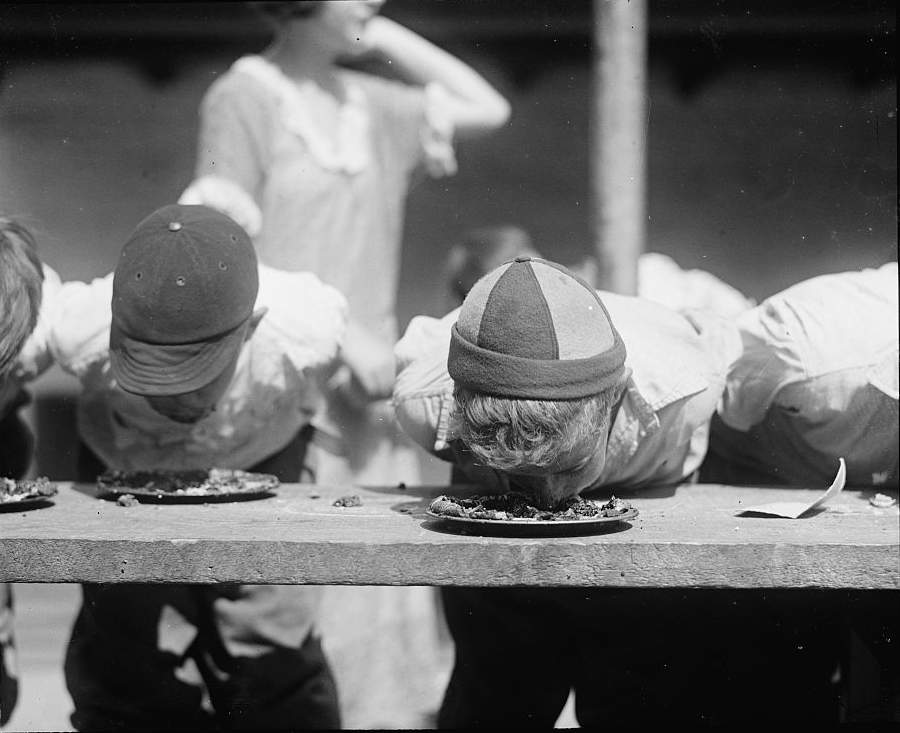
Pie_eating_contest_1923Once upon a time, there was a guy who decided that this was the day he was going to win the nuclear pie-eating contest. His girlfriend told him he was being foolish.

He said to her defiantly, “I can break the record. Those other people have limited willpower, and I am the king of contests.”

“No, you can’t,” she said. “It’s no good trying to defy nature. The size of your stomach is finite. It’s been proven definitively. It’s de-finite-ly true.”

But he ate the pie anyway, because he knew he was defin-ate-ly right.

And exploded.

He destroyed an infinite number of planets. What a jerk.

I guess his intelligence was finite, too.

Definitely.

***

This post is dedicated to Pat Sponaugle and Nicole Roder. Thanks for reading!

Image from Wikimedia Commons

For further reading on definitely, please check out these links:

Common Errors in English Usage: Definate

Time For A New Year’s Resolution? Definately? Defiantly? Definitely!

Stay tuned for Monday’s post, where I will endeavour to entrap the elusive letter E…


© Sue Archer and Doorway Between Worlds, 2015

Rogue Words from A to Z: The Cruelty of Crullers

A to Z Letter CHave you ever been certain you knew the right way to spell a word, and then found out you were wrong?

For A-Z, I was asked about the proper spelling of my favourite type of doughnut: cruller or crueller?

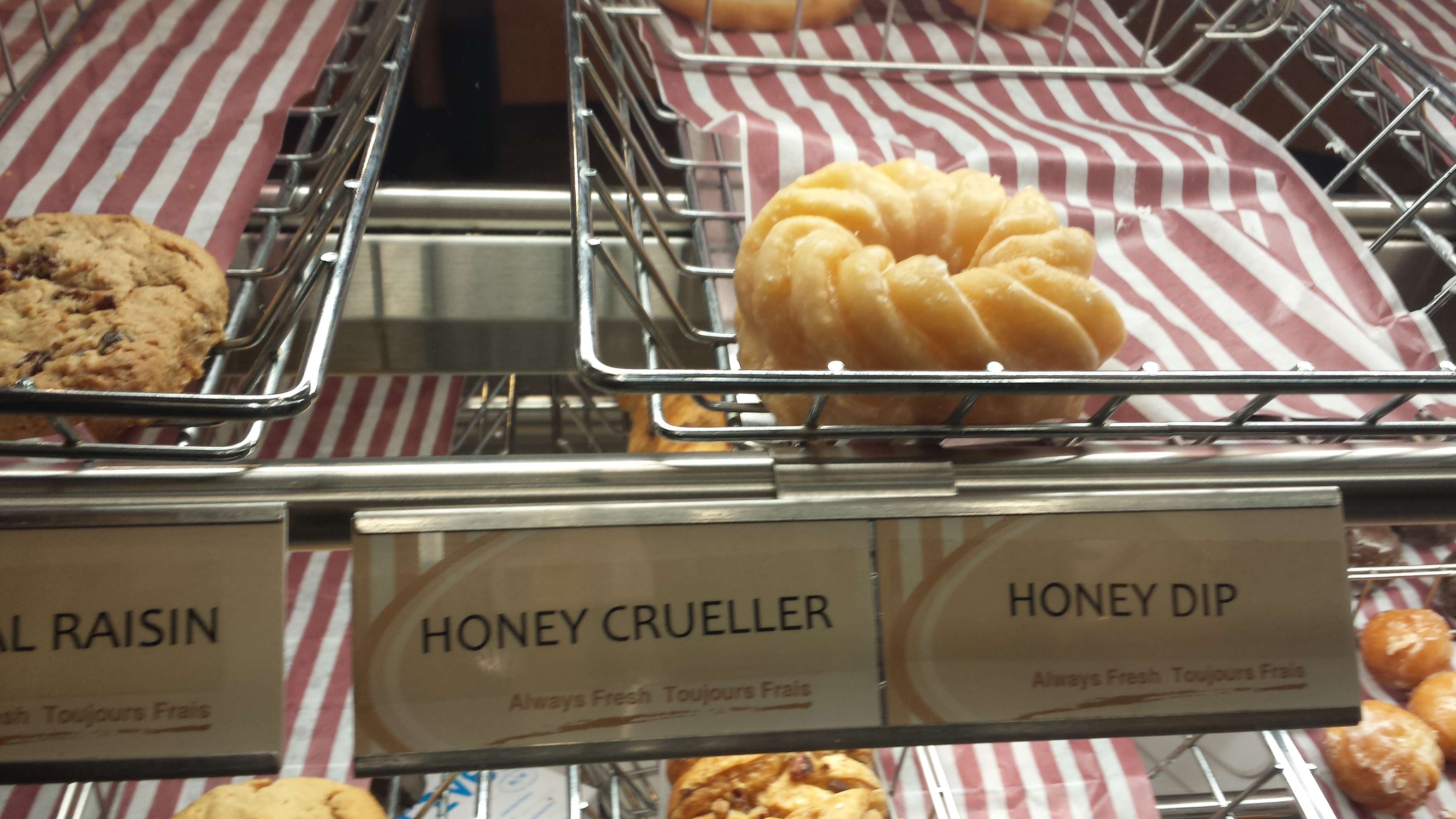
My first reaction was to say, “Crueller, of course!” I have been eating honey cruellers (sometimes know as French cruellers) at my local doughnut shop since forever, and the shop always spells it as crueller.

honey crueller or cruller

Here’s the proof, in case you doubt me…

Imagine my surprise when I looked this up online and found that the dictionaries spell this marvelous mouthful as cruller.

Merriam-Webster tells us that cruller comes from the Dutch word krulle, a twisted cake, from krul, which means curly.  I then went on to find out that Dutch immigrants were involved in the creation of the modern American doughnut.

If cruller is correct, I thought, why do I keep seeing cruellers in some (but not all) of the doughnut shops?

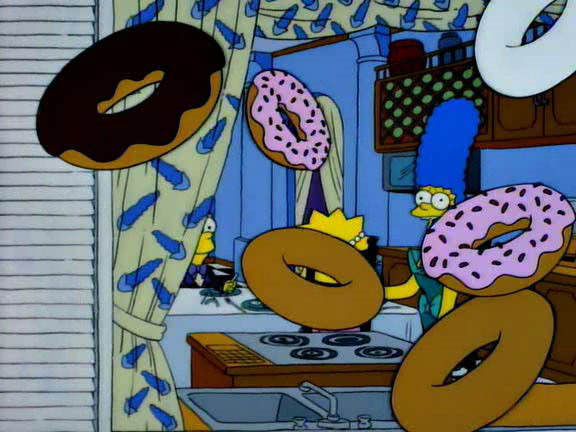
The easiest explanation is that Homer Simpson has been at the time-travelling toaster again and keeps changing history. In one universe it’s cruller, in another it’s crueller, and in a third it’s simply known as rain. Too bad Homer (and the rest of us) didn’t get to stay in that last universe. Those Simpsons writers are just plain cruel.

simpsons-treehouse-of-horrors-time-punishment

“It’s raining again.”

I’ve since found a better explanation. It turns out that crueller is the proper spelling in Pennsylvania Dutch country. They even have types of cruellers I’ve never heard of, like a coconut crueller. Mmmm…

So it turns out that both of these spellings are correct. Now I can focus on enjoying the sweet taste.

***

Image of crueller is mine; Rain of donuts is from The Simpsons: Treehouse of Horror V story “Time and Punishment”

This post is dedicated to Jaso, a fellow lover of cruellers.

What’s your favourite doughnut? And do you spell it as doughnut or donut?

Stay tuned for tomorrow’s post, where I will demolish the dastardly letter D…


© Sue Archer and Doorway Between Worlds, 2015


Rogue Words from A to Z: Braying About Braids

A to Z Letter BIt’s amazing how many vowel combinations can be used to make the same sound. Take the long “a” sound, for example. This sound can be written using ay, ai, ey, ei, or a/consonant/silent e. Then there are the exceptions. I salute anyone who takes on English as a second language, because it’s a mess.

There are a lot of these tricky words, but I’ve been asked to talk about the word braid. How do you remember how to spell braid? With the help of Shrek, naturally.

Who would you rather be – Princess Fiona or Donkey?

(I really hope you said Fiona.)

Princess Fiona

And here she is, folks…

Whether Fiona looks like a human or an ogre, she’s got wonderful hair. Her hair is often styled in a rope braid. A rope braid consists of two strands of hair wrapped around each other. If a braid has at least three strands, it can be called a plait.  Fiona likes to plait her hair into a braid. Both of these words make the long “a” sound using ai. (Just like the word hair.) So think about Fiona plaiting her hair, and you will remember how to spell braid.

Note: If you’d rather be Donkey instead, you will be remembered as a creature with bad hair who constantly brayed at everyone. Instead of showing off your beautful plait, you will be tempted by waffles on a plate and will force your friends to have to rescue you from your idiocy.

So please be Fiona, and enjoy your braid.

***

Update: Given all the discussion on this post, I’ve updated the definitions of plait and braid, to avoid any confusion. 🙂

Image of Fiona from Shrek

This post is dedicated to Nicole De Courval. Thanks for reading!

Stay tuned for tomorrow’s post, where I will chase after the cruel letter C…


© Sue Archer and Doorway Between Worlds, 2015