Shortly after I started DBW, I ran across Lori MacLaughlin’s blog Writing, Reading, and the Pursuit of Dreams. With a blog name like that, how could I resist investigating? At the time, Lori was in the thick of the A to Z Blogging Challenge, and I loved following her series of posts on favourite fictional characters.
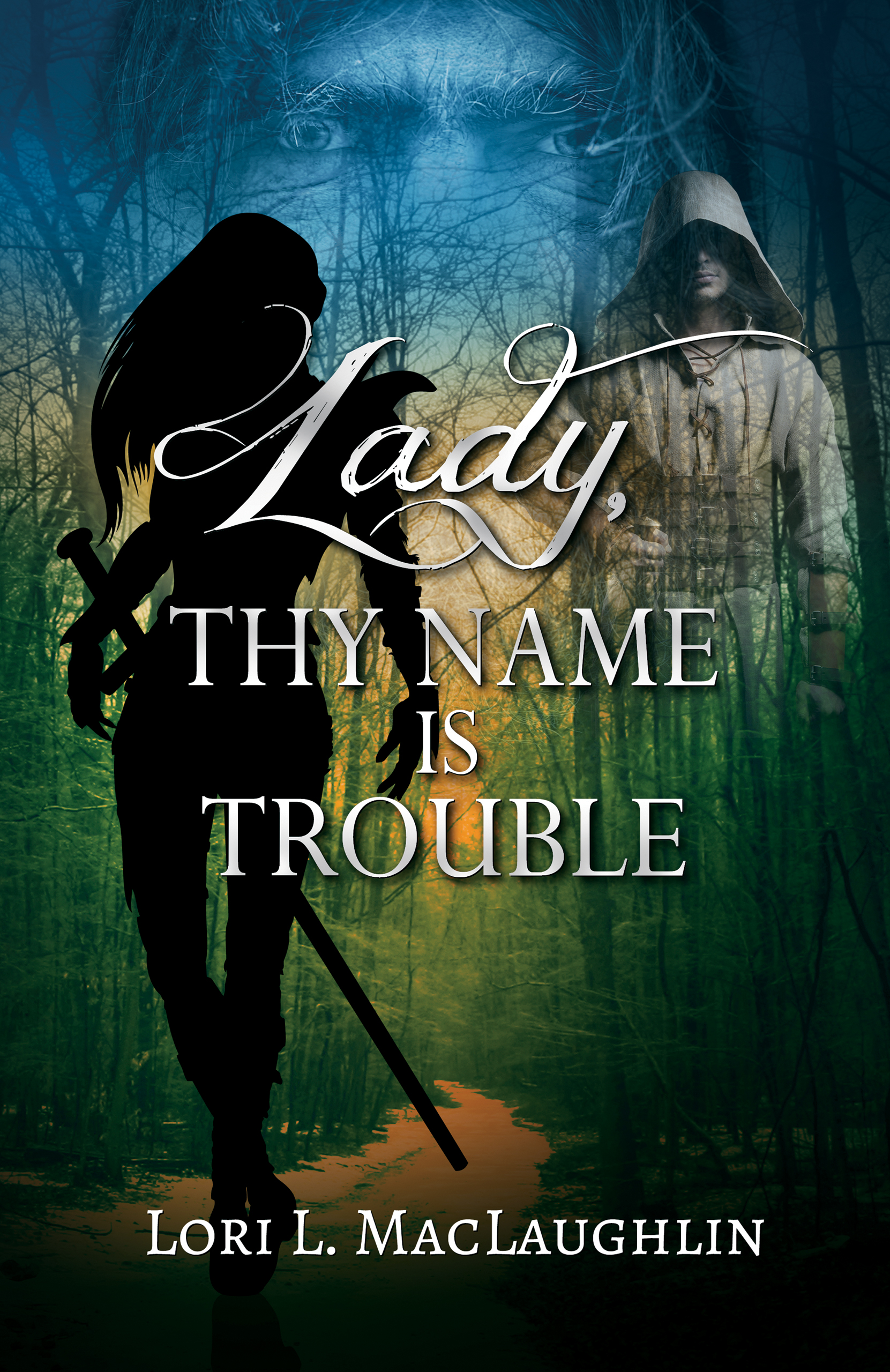
Since that time, she has chronicled her self-publishing journey, and recently published her first novel, a wonderful sword-and-sorcery adventure called Lady, Thy Name is Trouble. I asked Lori if she would be willing to stop by and share her thoughts on writing and communication. Here is our conversation on finding inspiration, interpreting body language, surviving the self-publishing process, and squawking.
On your About page, you talk about imagining tales while growing up on your parents’ dairy farm. How did your love for story come about? Who or what inspired you?
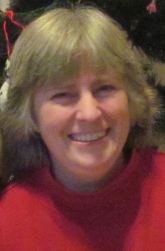
Lori MacLaughlin
I read voraciously while I was growing up. My parents had instilled in me a love of books by reading to me at an early age. They had shelves of books that filled my head with stories and sparked my imagination. Many of them had animal protagonists, like The Poky Little Puppy and other Golden Books, the Thornton W. Burgess Green Meadow series, and one of my favorites, The Wind in the Willows. Another book I found inspirational was The Phantom Tollbooth by Norton Juster. The idea of traveling through some kind of portal to a magical world fascinated me and inspired me to create my own fantasy worlds and adventures.
I was very much a tomboy and spent a lot of time in the woods and pastures and in the barns with our animals, so it was very easy, by extension, to think of them and other real and imaginary woodland critters as story characters. I’ve always been intrigued by fantastical creatures and wished I could see unicorns and fairies and such in the woods.
There is something magical about animals, isn’t there? I grew up in the suburbs, so I didn’t have a lot of opportunities to be around animals. But one house I lived in had a little pond down the street, and I used to love going on toad-catching expeditions and watching for squirrels.
I noticed when reading your book Lady, Thy Name is Trouble that you did an excellent job describing the horses and how they behaved. Did you work a lot with the animals on your parents’ farm? What was that experience like?
Thank you! Yes, I worked with both cows and horses. I had a saddle horse and enjoyed riding. My dad loves horses, and his stories about his experiences both riding and working with horses on the farm where he grew up were inspirational, too. Mostly, though, I worked with the cows and young stock. Interacting with the animals was my favorite part of farming. Each animal had its own personality, and I really got to know them well. Animals have body language and expressions, just like people, and being able to read those allowed for so much better interaction with them. I found I had a way with animals. There were skittish cows and calves that I could do anything with that no one else could get near.
That’s wonderful. My experience with farm animals is largely limited to a pony that stepped on my foot at summer camp. I was quite intimidated, and I’m sure it showed! That’s a true skill to be able to read body language. Non-verbal communication is so important, and yet it’s something that a lot of us have trouble with. Have you found that this skill at observing others has helped you in other areas of your life? Does it affect how you approach your writing?
Ouch. That had to hurt. Yes, I’ve found that it helps immensely in communicating with others. Some years ago I worked as a feature writer for a local newspaper, and the job involved interviewing people from all walks of life for various reasons. By listening to them and watching their visual cues, I was able to find an approach that put them at ease and got them to open up and really talk to me. It was very rewarding to communicate on that level. Just the simple act of listening — giving someone your full attention — works wonders.
Observing body language was also important in a job I had as a clothing salesperson. I was required to greet the customers who came in the store and ask if they needed help with anything. The customer’s tone of voice and body language told me quite clearly if they didn’t want help at all or might want help later and wouldn’t mind being approached again. It also helped tremendously with children. I worked for a number of years as a kids’ shoe fitter. It’s not always easy to get kids, ages 1 to 10, to cooperate during the fitting process. Being able to read them helped me find ways to coax them into cooperating and made the experience a lot more pleasant for everyone involved.
Because non-verbal communication is such an integral part of expressing oneself, I try to include as much as feels natural in my writing. Expressions and gestures say so much more than just words and really bring characters to life.
Speaking of bringing characters to life – you recently published your first novel, Lady, Thy Name is Trouble. Congratulations! I am sure you went through a lot of work to make this happen. How did you come to the decision to self-publish your story? What has the experience been like for you?
Thank you! Yes, it took a LOT of work. I began writing this story as a hobby many years ago. As I began to get more serious about my writing, I read how-to books on improving my craft and joined a writer’s group to get feedback, which was so helpful. Eventually, I hired a freelance editor and proofreader, whom I met through the League of Vermont Writers group. She loved my story and understood my writing style. Her suggestions brought the story out from under a pile of extraneous words and really helped it shine. From going through this process, I learned how to self-edit, so my work is much cleaner from the start.
I began sending out queries to agents in the traditional manner, hoping to land representation that would keep me out of the publishing houses’ slush pile. I garnered some interest, but no takers. Some responses came right away. Others took months. To wait that long, only to receive a standard rejection letter was discouraging, to say the least.
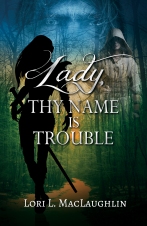 After a couple of years of not getting anywhere, I decided to re-evaluate. It seemed like there were fewer and fewer opportunities for unpublished writers in the traditional publishing world, and the books that were coming out in my genre were mostly young adult and paranormal/urban fantasy. My novel, I think, would be described best as sword and sorcery, with the emphasis on the sword. It’s action and adventure with romance thrown into the mix.
Not wanting to spend many more months or even years waiting for acceptance from an agent, I chose to go the self-publishing route. My decision was also influenced by the fact that if I did it myself, I would have control over every aspect of the publishing process. Having heard and read about problems other writers had encountered with publishers, this aspect particularly appealed to me.
I have learned so much since taking the plunge. I started building my social media platform. I researched the pros and cons of Amazon’s CreateSpace vs. publishing under my own imprint and decided if I was going to do it myself, I was going to do it my way, to quote an old Frank Sinatra song. I started my own company, Book and Sword Publishing, and registered it with the state, going through a lawyer to make sure I didn’t make any mistakes. I bought my own ISBN numbers. I learned about book layout and cover design, book reviews, and blog tours. I taught myself how to edit music and make book trailers. So many things. I made a list at the beginning of this process of all the things I’d need to do. It seemed a very daunting list, but as long as I took things one step at a time, it was doable. I’ve had my share of frustrations. My successes, though, have blown them all away. There are no words to describe how it feels to hold my own book in my hand or to read it on my Kindle.
Wow, you have been busy! I’ve seen your book trailer, and it’s fantastic. I think it’s wonderful that you’ve tackled all the different aspects of publishing your book. Do you have any advice for writers who are thinking of going the self-publishing route? Are there any resources that you found to be particularly helpful?
Thanks! Yes, the book trailer was a lot of work, but it was fun to make. I think the most important thing for anyone who decides to self-publish is to hire professionals to edit and proofread your work. I know it’s expensive, but it will be worth every penny. A professional-looking cover is also a must. The only way self-publishing will lose its stigma is if everyone who goes that route puts out a quality product. The second-most important thing is to get on social media. Blog, Facebook, Twitter — use whatever works for you to connect with people. It’s the best way to get the word out about your book, and you get the added benefit of meeting and making friends with some wonderful people. Get on Goodreads and network with people there. You don’t have to jump in all at once. Start slow and build up as you feel comfortable.
There are a ton of online resources for self-publishers. I’ve found answers to almost every question I’ve had just by doing a search on a few keywords. Two sites that have been really helpful for me are the Insecure Writer’s Support Group at www.insecurewriterssupportgroup.com and The Book Designer at www.thebookdesigner.com.
I’ve also had good luck with Audacity music editing software and Calibre e-book conversion software, both free downloads off the Web. I purchased a template from the Book Designer specifically tailored for MS Word files that would be uploaded to the distributor Ingram/Spark, and that worked well. I used www.istockphoto.com for images for my book trailers. Their one-month subscription worked fine for me, and I had no problems with them, whatsoever. I found great music at www.freestockmusic.com. Font Squirrel has a good selection of fonts that are free for commercial use. I discovered not too long ago, in my naiveté, that even fonts must be licensed for commercial use before they can grace the pages of your books. Always be sure to obtain the necessary permissions and/or licenses for anything you use before publication.
Yes, it’s always good to be on the right side of the law. 🙂 Thanks so much for sharing your advice with DBW readers. I have one final question, just for fun. I noticed in your bio that you are a pilot. (From horses to planes – you really know how to go places!) I’ve written in the past about the perils of nonsensical corporate jargon. Have you encountered any weird or funny piloting jargon while learning to fly?
Thanks so much for having me here, Sue! Well, it has been a long time since I piloted an aircraft, but one thing that stood out to me was the constant use of abbreviations. For instance, I was licensed with a VFR, or visual flight rules, rating, which meant that I could fly using outside visual cues, such as the horizon, the landscape, buildings, etc. In other words, I could see where I was going. I was not IFR, or instrument flight rules, rated, so I couldn’t fly in places or at times when I couldn’t see outside and would have to rely solely on the instrument panel for altitude, pitch, direction, and so forth. All airports, in the U.S. anyway, are identified by a three letter code: Los Angeles, CA — LAX; Newark, NJ — EWR; my local airport in Burlington, VT — BTV.
Deciphering a weather report was like reading some kind of weird shorthand. Here’s an example of a PIREP (pilot report) out of my old Manual of Flight book:
DEN 275045 1745 F330/TP B727/SK 185 BKN 220/280 – OVC 290/TA -53/WV 290120/TB LGT-MDT CAT ABV 310
This means: “Denver VOR (very high frequency omnidirectional range) 275 radial 45 NM (nautical miles) at 1745Z (zulu time). Flight level 330 (33,000 ft.). Type of aircraft Boeing 727. Sky cover consists of two layers: first layer base at 18,500 ft., broken top at 22,000 ft., second layer base at 28,000 ft., thin overcast top at 29,000 ft., outside air temperature minus 53 degrees Celsius, wind 290 degrees true at 120 knots, light to moderate clear air turbulence above 31,000 ft.”
And here’s an example of radio communication from a student pilot ready to leave the airport:
Pilot: Ground Control, Cessna 69210 at Montair — going to the north practice area with information Alpha.
Ground Control: 210, taxi to runway 19. Departure on 121.1; Squawk 0325.
(This means turn your radio to frequency 121.1 so you can talk to Departure, and enter 0325 in your transponder so the air traffic controller can identify your aircraft on the radar screen.)
Pilot: Roger 210.
Sometimes it felt like I was speaking a completely different language. It was quite the experience.
That is definitely a different language. And I thought corporations used a lot of abbreviations! Thank you for giving me an inside view into the life of a pilot. And thank you for sharing all your helpful advice with DBW readers today. It’s been a great pleasure to chat with you.
***
Image courtesy of Lori MacLaughlin
For more about Lori, I encourage you to check out her blog or pick up her debut novel, Lady, Thy Name is Trouble.
Do you have a question for Lori, or a comment on our interview? Please continue the conversation below. We’d love to chat with you!
 Have you ever been certain you knew the right way to spell a word, and then found out you were wrong?



 Doorway Between Worlds