Attack of the Jargon Gorgon

As he climbed the marble staircase of the Temple of Empowerment, Perceiveus prepared himself to face his greatest foe: Mesnooza, the Jargon Gorgon. Her confusing words had paralyzed many heroes before him. Perceiveus was determined not to make the same mistake.

He reached the top and found Mesnooza waiting for him in the torchlit chamber. He averted his gaze, catching only a glimpse of her glittering eyes. Her features were hidden behind the wall of writhing serpents that gushed from her head like oil-slick tongues. He didn’t need to see the rest of her to know that she was hideous.
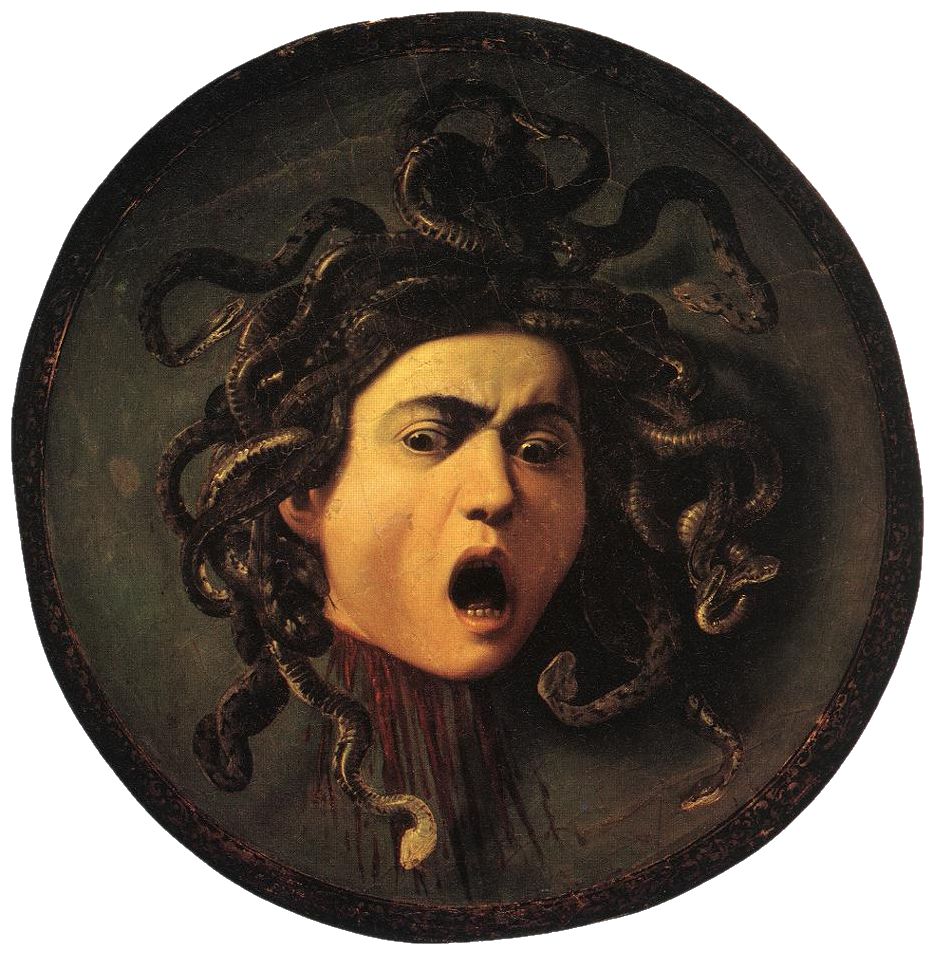
Medusa by Caravaggio

“So, your stakeholders have finally sent you to deliver the goods,” said Mesnooza, affecting boredom. “Well, you may have an impressive body of work, but you’re just the flavour of the month to me.”

“We hope you had a game plan before you took on this stretch assignment,” hissed one of her serpent locks.

“You can fire away, but you’ll never be buzzworthy,” pronounced another serpent.

“You think you’re bleeding edge, but you’ve had your heyday,” taunted a third serpent.

Perceiveus ignored the serpent chorus. He circled Mesnooza with caution as her serpents stretched towards him. He flung a dagger at her heart, but she danced away from it.

“I hope you level-set your tiger team, because a win’s not in the cards for you,” sang Mesnooza. Her serpent speakers echoed her.

“It’s time for you to eat a reality sandwich, and stop chasing butterflies.”

“Should have done your due diligence before giving in to blue-sky thinking.”

“Those red flags might have warned you that this was a career-limiting move.”

Perceiveus struggled to concentrate. He grabbed a torch from the wall and thrust it at the nearest serpent. It cried out in pain and went silent. Enraged, a nearby serpent bit his arm, denting his armour. Another serpent whipped him across the face, and he staggered back.

“I don’t think you’re giving this one-hundred-and-ten percent,” snarled Mesnooza, upset by the fiery attack. “Time to go back to the bush league.”

“Feeling hot under the collar?” sneered a serpent. “You’re on a burning platform, and you’re dealing with a bag of snakes.”

“Face it, you’re behind the eight ball. Time to pay the piper.”

“Too many balls in the air. You can’t hack it,” spat another serpent.

Hack it. Sword! In the confusion of battle, Perceiveus had forgotten his primary weapon. He drew his blade and began slicing through his reptilian enemies.

“You might think you’re making an impact, but I’m not low-hanging fruit,” panted Mesnooza, as she dodged his blows. Her serpents were not faring as well. Their voices became weaker as their numbers diminished.

“You might be gaining traction, but you haven’t moved the needle,” one murmured as it went unconscious.

“You think you have your ducks in a row, but we’re playing hardball,” whispered another faintly.

“Time to…think outside the box!” croaked a wounded serpent, before Perceiveus cut its neck clean through.

Mesnooza was exhausted. No one had ever stood up to her power, and she did not know what to do. Her single remaining serpent seemed to realize the game was up.

“Let’s get down to brass tacks and bottom-line it,” said the serpent. “It’s cut and dry that it’s time to put this to bed. Time to fish or cut bai-”

Perceiveus looked up from the serpent’s severed head. “It’s over, Mesnooza.”

But Perceiveus had made the mistake of looking Mesnooza in the eye. Now that she was no longer hidden behind her jargon serpents, Perceiveus could see her true face. She was the most beautiful woman that he had ever beheld.

“I’m sorry I caused you trouble,” she said. “I feel so free now, like a great weight has been lifted from me.”

Perceiveus was stunned into silence.

While Perceiveus stared, Mesnooza slipped away through a side door and escaped from the temple. Who knew that I could stop men in their tracks without my jargon? she thought. Enough of that ugliness. It’s time for me to start a new life. And I’ll create a new name to go with it. Hmmm. I’ve always liked Helen…

***

Image: Medusa by Caravaggio. Source: Wikipedia.

I hope you enjoyed my retelling of Perseus and Medusa. This story was inspired by my difficulties in cutting through jargon in a business environment. What jargon have you heard that brings on your fighting spirit?


My Writing Process (Blog Hop)

Talented writer and fellow blogger Andrew Knighton recently tagged me for a writing process blog hop. So of course I said yes! My hop post will probably be a bit different from the norm, since my personal writing is focused on blogging (for now) rather than traditional stories or novels. My day job involves a lot of business/technical writing and editing for a corporation. My blog gives me a chance to show off my creative side.

1. What am I currently working on?

I started Doorway Between Worlds four months ago. I write weekly tips about communication through the lens of sci-fi/fantasy. I also proofread for Editors’ Weekly, the official blog of the Editors’ Association of Canada.

At my day job, one of my current focus areas is writing online help that is useful, clear, and easily accessible. So I have been learning a lot about information architecture, user experience, and plain language. The plain language aspect is filtering into my blog, because I try to write posts that are readable for a wide audience. As someone who has spent years explaining technical concepts to the business side, I strongly support plain language and clear communication.

In the back of my mind are many story ideas. When I have more time to devote to writing, I’d like to explore them. These include ideas for a traditional epic fantasy story, a post-infrastructure collapse apocalypse story, and an adventure story about a family that saves the world.

2. How does my work differ from others of its genre?

I am a big fan of Grammar Girl because she writes about grammar in an accessible and entertaining way. I wanted to take things one step further by writing communication tips in the form of stories. I have seen other people do this, but usually the story is limited to a few sample sentences with a lot of exposition in between. I am working towards fully integrating the information into the stories. I’d like the story metaphor to seamlessly reinforce the learning. I’m not there yet, but that’s my goal. Can I write fun stories about grammar that are just as entertaining as a traditional story? We’ll see…

3. Why do I write what I write?

I started my blog for a couple of different reasons. I wanted to share what I’ve learned about communication in a fun way, so that I could help others who are interested in this topic. I also wanted to start writing creatively again, because ever since high school, all my writing has been analytical. My dream as a child was to write a fantasy novel, and that hasn’t changed. But I’m out of practice. Writing this blog is helping me use those parts of my brain that have been sadly neglected.

4. How does my writing process work?

I use a form of writing prompt to come up with post ideas. I have two lists: a list of communication problems I would like to help people with, and a list of sci-fi/fantasy settings and concepts that I enjoy. Then I try to connect the two of them together.

Statue holding a stylus in front of a beautiful sunset at Piazza di Spagna in Rome, Italy

Do you feel this serene while writing? I wish I did!
(Image sourced from gnuckx at Wikimedia Commons, CC-BY-2.0)

Sometimes I start with a problem, like the time I was trying to figure out how to write a story about apostrophes. This seemed impossible, until I thought about how nice it would be if someone could just take them away. And so Night of the Apostrophe Ninja was born. Other times there’s a concept I really want to write about, like vampires. What do vampires do? Suck the life from people. So then I ended up writing about how passive voice sucks the life from sentences in Tale of a Sentence Vampire Hunter.

Once I have a basic idea, I let it kick around in my head for a couple of days. (My best thinking times happen while I am commuting, out walking, or, unfortunately, trying to get to sleep.) I typically write the first draft in one shot. I let it sit for a day and come back to edit it before posting. I used to spend a lot more time editing. I’m starting to get used to the blogosphere, where speed is more important than perfection.

5. Tag three other writers for the blog hop

A lot of writers I follow have already been through this blog hop, so this is a tough one. There are three writers I admire who have a knack for humour in their posts. I’d love to find out more about how they write:

Celine Jeanjean

Brenna Layne

Shelley Sackier

Ladies, if you would rather not blog hop, I understand. Feel free to post a link in the comments below to one of your favourite posts so I can share your greatness!

And finally…N J Magas has already done this blog hop, but I wanted to share her fantastically funny post: In the Back Abyss Without a Light or My Writing Process.

Thanks for reading!

Warning: Mixing Your Modifiers May Cause Explosions

Who can forget the daily drama of potion class with Professor Snape? If you’ve read (or watched) Harry Potter, then you know what I’m talking about. Harry and Ron are hopeless at modifying their potions. There’s always some kind of mix-up. The two Hogwarts students are often bracing for an explosion: Malfoy’s explosive laughter, Snape’s explosive rage, or their own explosive cauldron. If they didn’t have the help of clever Hermione, Harry and Ron would never get through it.

This makes no sense at all! Where's Hermione?

This ingredient list makes no sense at all! Where’s Hermione?

If you think modifying potions is hard, that’s nothing compared to modifying words or phrases. You need lots of butterbeer to get through the mix-ups that can happen when you use modifiers. You can have misplaced modifiers, dangling modifiers, or squinting modifiers. And there’s no Dumbledore to give you guidance. (Luckily, you have me.)

Misplaced Modifiers: May Cause You to Vomit Slugs

With a misplaced modifier, you are modifying a word you didn’t intend to modify. You can avoid this problem by putting your modifier just before the word you are modifying. Do this and you won’t be like Ron, who modified himself instead of Malfoy when he misfired a spell. Then he got stuck with a sluggish digestive system.

To illustrate misplaced modifiers, let’s talk about how bad Harry and Ron are at making potions.

Harry and Ron messed up almost every potion.

Wow, Harry and Ron are terrible at this. This means that most of the potions they make are failures (almost all of them). But what if the situation is not quite that dire?

Harry and Ron almost messed up every potion.

Okay, things aren’t so bad now. They almost messed up every time, but managed to pull through. (Maybe Hermione was whispering the answers to them.)

You can see that where you place almost makes a big difference in the meaning of the sentence.

Let’s say our two fledgling wizards don’t know how to answer Snape’s question about a potion. Snape is not amused.

Snape yelled only at Harry.

Phew, Ron got out of it this time! Only Harry is being yelled at. But maybe I meant to say this instead:

Snape only yelled at Harry.

Snape hated Harry so much that he only yelled at him. He never talked to him or whispered to him. He just yelled. Everyone pulled out their earmuffs from Professor Sprout’s Herbology class whenever Harry and Snape were in the same room.

Misplaced modifiers can happen with modifying phrases, too.

Thundering towards them, Ron was afraid that Snape would transmogrify them into slugs.

Who is thundering towards Ron and Harry? It looks like Ron is doing the thundering, which makes no sense (unless he used the time turner, and there’s two of him). Let’s put that modifying phrase next to the word we want to modify (Snape):

Thundering towards them, Snape made Ron afraid that they’d be transmogrified into slugs.

Now it’s clear who is being modified in this sentence. And it’s not Ron (fortunately for him).

Remember: Misplaced modifiers = slimy slugs + Snape in a rage. They are bad news.

Dangling Modifiers: May Cause Dizziness While Flying

With a dangling modifier, the modifier is describing something that isn’t even in the sentence. It’s hard to identify what’s being modified (so you’re left dangling). You can avoid this problem by making the subject of the sentence clear. Don’t be like those clueless students who couldn’t identify who was causing Harry to dangle off his quidditch broom. (The dementors, of course.)

To illustrate dangling modifiers, let’s continue with our potions story. Ron couldn’t answer a potion question, and now he is worried about a raging Snape.

Cowering at his desk, Hermione waved her hand frantically.

Who’s cowering at a desk, and what does that have to do with Hermione? Right now, Hermione is the subject of the sentence, and she’s too brave to cower. Let’s fix this by adding in the true subject (Ron).

Cowering at his desk, Ron saw Hermione wave her hand frantically.

Hurrah! Hermione is coming to save the day by answering that question! Ron owes her big time.

Let’s try another dangler:

While blurting out the answer to Snape’s question, Snape sneered.

Apparently Snape doesn’t like it when he blurts out the answer to his own question! Wait a minute, that can’t be right…

While Hermione blurted out the answer to Snape’s question, Snape sneered.

Of course Hermione knows the answer. Bless you, Hermione. You are too good to Ron and Harry. But now that you are the subject of the sentence, you’ve put yourself in Snape’s way…

Remember: Dangling modifiers = Quidditch match injuries + Snape in a bigger rage. They can cause a lot of damage.

Squinting Modifiers: May Cause Headaches and Confusion

Our final modifier culprit is the squinting modifier. A squinting modifier happens when the modifier is placed between two things, and you’re not sure which one it modifies. You keep squinting to make it out, but it gives you a headache. You can avoid this by rewriting your sentence. Yes, that takes work. But it’s easier than figuring out the real Harry when a bunch of wizards drink Hermione’s polyjuice potion and look like Harry. Confusion to all Death Eaters! (But hopefully not to you.)

Ready to start squinting?

Snape’s attention is now focused on Hermione, who is trying to answer the potion question.

“Children who seek attention rarely are intelligent,” pronounced Snape darkly.

Ouch! But what is Snape saying? Is he saying that children who seek attention once in a while (rarely) are intelligent? I’m guessing that’s most of his class (including Hermione, who’s learned not to seek his attention except under desperate circumstances). Nope, that’s too nice for Snape. Does he mean that children who like to get attention are usually stupid? Probably. But the sentence is not clear, because the modifier rarely is between attention and are intelligent.

Whatever he said, Hermione doesn’t like it. And she knows how to master modifiers.

“Teachers who bully others often are compensating for their insecurities,” retorted Hermione.

Does Hermione mean that teachers who bully others a lot (often) are insecure? Or does she mean that teachers who bully others are often insecure? It could go either way here. If Hermione wanted just the second meaning, she would have said “are often” instead of “often are.” But Hermione is trying to give Snape a headache thinking it over. Great job, Hermione!

(But maybe not so great for Gryffindor house.)

Remember: Squinting modifiers = Hermione’s clever double meanings + Snape in a towering rage. They cause a loss of fifty house points from Gryffindor.

But it was worth it.

***

This post is dedicated to TL, who asked me to write about where to place modifiers in a sentence. If you have a topic request for a future post, please contact me.

Night of the Apostrophe Ninja

Like many of his neighbours in the sleepy small town of Anywhere, Bob was puzzled by the mysterious word its. When should he use an apostrophe? Bob was known as the best writer in town, and he dreaded everyone finding out his shameful secret.

Bob did know that apostrophes could do two things:

1. Show the reader that two words have been put together and letters have been removed.

2. Show the reader that an object is being possessed by someone or something.

So it made sense to Bob that people might write things like Bob’s a really smart guy. (If they only knew!)

Bob understood that Bob is could be contracted into Bob’s, with the apostrophe showing that there were missing letters.

Bob was also familiar with I always go to Bob’s house when I need some advice about apostrophes. (Oh, the mounting pressure!)

Since Bob owned his house, it made sense to write Bob’s house.

Bob was comfortable using apostrophes with almost any noun for the two situations. But then there were those exceptions he just didn’t understand: it, you, and they. He wasn’t comfortable deceiving his friends into believing he was a punctuation expert. He needed to figure this out. Maybe tonight he would finally master it.

Nancy’s coming over here tomorrow for apostrophe advice, Bob thought, and I’m worried about whether I have this right. Ha! The dog’s barking. It’s happening again. I must find out who is helping me!

Every night, Bob was being visited by a mysterious apostrophe thief. This stealthy punctuation master would slice out all the apostrophes that didn’t belong and take them away.  Bob had never caught a glimpse of his visitor. He was left with only the results—accurate sentences.

Over time, Bob had noticed a pattern. Those vague and disturbing pronouns it, you, and they often had apostrophes going missing into the night. For these words, an apostrophe was left behind only for a situation where Bob was putting words together:

It’s strange that this is happening. [replacing It is]

You’re not going to believe this. [replacing You are]

They’re wrong about me being a punctuation genius. [replacing They are]

When Bob was writing about the possession of something, the apostrophes disappeared. Instead of it’s, you’re, and they’re, he was left with its, your, and their.

If only the town knew its resident writer was not the true source of punctuation knowledge. [the resident writer belonged to the town]

My dog always barks at your arrival, oh mysterious visitor. [the visitor controls the arrival]

But the townfolk go on their merry way, unaware of who is in their midst. [the townfolk are responsible for their oblivious activity]

At the sound of the dog barking, Bob sprinted into his home office. He found a shrouded figure crouched on his messy desk, claws resting lightly on the surface. Bob halted in the doorway.

He whispered, “It’s you! You’re the one who’s been stealing my apostrophes and preserving my reputation! They’re treating me like I’m a genius, but you’re the one who truly knows!”

The ninja slowly nodded its head.

“Oh, great punctuation master, please tell me if I have learned the pattern correctly for it, you, and they. When you’re contracting words, you use an apostrophe. But when you want to show possession, you do not use an apostrophe. Your teachings have taught me this. I will now be able to truly help the townspeople with their punctuation. Am I correct?”

The ninja nodded its head again.

“May the town know its true benefactor?”

In the blink of an eye, the apostrophe thief sprang out the window and disappeared into the night.

komori ninja

Image Credit: Komori by Gary Dupuis. Stock art purchased from http://www.rpgnow.com

Holding his breath, Bob approached his desk. None of the apostrophes had been removed from his papers. He had finally achieved mastery!

The town slept on, unaware of one man’s secret triumph.

How to Escape from That Wicked Which

Once upon a time, there was a golden-haired princess who lived in a tiny room at the top of a tall tower. She never needed to choose between which or that when she wrote sentences in her diary. This was because she didn’t have many choices at all.

When she was a baby, she was stolen from her parents by a wicked witch, who locked her up in the tower. The witch had told her all about the scary place called Outside, and she hadn’t tried to leave while she was growing up. But now she was a teenager, and getting bored with solitude. She was also getting tired of writing the word which.

***

Dear Diary,

Nothing ever changes around here. The witch has warned me not to leave this place, but I am so bored! The rocking chair, which is over by the fireplace, is still empty.  I want to meet someone! I tried putting my old doll, which has red hair, in the chair to keep me company. But it’s just not the same. When will anything ever happen in this place?

***

The princess used the word which a lot in her diary because most of the things in the tower were unique. She didn’t have to single out a thing from all other things of the same type, so she used the word which to describe them. (Otherwise she would need to use that, which distinguishes between things.)

She didn’t need to write “that doll with the red hair” because she only had one doll. She provided the information that the doll had red hair, but the reader wouldn’t need to know this to identify the doll.

And she didn’t need to write “that rocking chair by the fireplace” because there was only one rocking chair, and it always sat by the fireplace.

Anything described using which is considered “non-essential” information. It can be removed from the sentence without affecting its meaning. (This is why this information is generally placed between commas or parentheses.) The princess could just as easily have written the following:

***

Dear Diary,

Nothing ever changes around here. The witch has warned me not to leave this place, but I am so bored! The rocking chair, which is over by the fireplace, is still empty.  I want to meet someone! I tried putting my old doll, which has red hair, in the chair to keep me company. But it’s just not the same. When will anything ever happen in this place?

***

One day, a handsome prince hacked his way through some vines (ruining his fine sword) and discovered the princess in the tower. He called up to her and told her not to worry—he would find a way to rescue her. She cheerfully yelled down that there was no need. She had figured out how to unlock the tower years ago, and now that something exciting had happened, she was ready to leave. The prince was a bit nonplussed by this, but recovered (and started preening) as he saw her striding towards him with a beaming smile on her face. Maybe it’s a good thing that he didn’t know what she was thinking.

***

Dear Diary,

Today something exciting finally happened. I got to meet a horse! He isn’t like the horse that is in my picture book. He is gleaming white, rather than being black all over. The horse is very nice—not at all like those girl-eating horses that the witch described to me. Oh, and I met a boy, too! He said I could decide which path to take. I was so happy to choose! I asked him, “What’s at the end of the path that follows the river?” He told me it led to his castle. It turns out that he is a prince! Then I asked him, “What’s at the end of the path that goes over the big hill?” He told me there was a town, and they were having a festival today. I’ll bet you can figure out where I went!

***

Our resourceful princess finally got to use that instead of which. She needed her reader to understand that the white horse was not the same as the horse in the book or the horses described by the witch. The reader also needed to know which of the two paths the princess was describing. All of the information is essential, so nothing can be eliminated. (That’s why the information is not surrounded by commas.) Otherwise, we’d have this wonderful nonsense:

***

Dear Diary,

Today something exciting finally happened. I got to meet a horse! He isn’t like the horse that is in my picture book. He is gleaming white, rather than being black all over. The horse is very nice—not at all like those girl-eating horses that the witch described to me. Oh, and I met a boy, too! He said I could decide which path to take. I was so happy to choose! I asked him, “What’s at the end of the path that follows the river?” He told me it led to his castle. It turns out that he is a prince! Then I asked him, “What’s at the end of the path that goes over the big hill?” He told me there was a town, and they were having a festival today. I’ll bet you can figure out where I went!

***

The princess enjoyed her time at the town festival. There were so many activities to choose from.

She danced with many of the townspeople.

(Dear Diary, The boy who had short brown hair danced especially well.)

Then she watched a stage play.

(The sole actress, who played the witch, was not very talented. But I enjoyed it anyway!)

She also fed apples to the magnificent horse.

(I wish I had a horse just like this one!)

***

You can see that the idea of essential vs. non-essential information also applies to the word who. If the information is placed between commas or parentheses, it is non-essential and can be eliminated. (Dear Diary: The sole actress, who played the witch, was not very talented.)

***

Eventually, the prince got bored. He said that it was time to go home to his castle, where he would marry her. She told him that he was crazy—why would she marry him, when she had all of these choices before her? The prince attempted to ride off in a snit, but the horse decided he would rather stay with the princess. So the prince ended up limping home.

Disney's Tangled - Horse and Rapunzel smirking at the prince

And they all lived happily ever after!
(Image from Disney’s Tangled)

THE END (for now – look for more grammar story excitement in future posts!)

P.S. The rules that I describe for which and that are based on North American style guidance. So don’t be surprised if you run into which in a text from England where others would use that. The rules about using commas for non-essential information, however, are still the same. Please feel free to share any of your which (or witch) stories below. Your comments are always welcome!

Networking in a Strange Land

This past weekend, I attended the Editors’ Association of Canada annual conference. I had been looking forward to this event and I was not disappointed. The weekend was jam-packed full of sessions on self-publishing, social media, and the future of editing in the digital space. Plus, I had a chance to meet people like fellow blogger and awesome grammarphile Suzanne Purkis from Apoplectic Apostrophes.

I knew going in to this conference that it would be a great opportunity to network with writers and editors that I hadn’t met yet.

Wait a second…I was going to have to talk to new people all weekend? Ummm….

All of you introverts out there know exactly how much *fun* it is speaking with groups of people at large events. We’re the strangers in a strange land, hoping that someone will grok us immediately so that we don’t have to exhaust ourselves putting on a show. We always have a sneaking suspicion that other people have figured out we don’t belong here.

John Carter among the Tharks - What do you think? Should we toss him out, or have fun with him first?

What do you think? Should we toss him out, or have fun with him first?
(Image from John Carter)

Luckily, I was not the only one feeling this apprehension. There was a popular discussion on the EAC LinkedIn group before the conference on networking for introverts (where many of us sang the praises of Susan Cain’s Quiet). EAC member Elizabeth Macfie chimed in by writing an excellent post full of networking tips. Armed with this information, I bravely went forth and connected with many people. I even managed to find other fans of speculative fiction, like word sorceress Vanessa Ricci-Thode and graphic novel editing guru Alison Kooistra.

I’d like to share with you some of the networking tips that helped me survive my trip to this alien land known as a “business conference.”

Sue’s Networking Tips for Introverts

1. Try to know people before you go. See what you can find out about the people who are attending or speaking at the event. Look at their pictures on LinkedIn so that you will recognize them when you see them. Find out what they write about or what they post on their websites. The strange will become familiar, and you’ll have a starting point for a conversation.

(I was lucky that the EAC had a conference buddies program, where you could email with people ahead of the event and not feel alone when you got there. This was a great boon for introverts. Thank you to Jean, Anne, Avery, and Marie-Christine for being my conference buddies!)

2. Dress for confidence. Wear the outfit that makes you feel like you’re a star. You’re not there to blend in—you’re there to show your best self. Stop worrying about being different and celebrate those differences. At the conference, I saw someone wearing an unusual knit dress and another person wearing a tiara. Both of them pulled their outfits off with panache.

3. Keep your cards ready. You don’t want to be fumbling over your business cards and feeling like you have too many fingers as you try to make connections. Networking can be awkward enough. Put your cards in your name tag holder so that you can take them out quickly, and put other people’s cards at the front so you don’t mix the cards up.

4. Take a break. You can’t be “on” all the time. Spend five minutes wandering away to a quiet place and drink a coffee in silence. Pretend you’re out in deep space. Take the opportunity to study your agenda so you know where you’re going next. You don’t want to waste your mental energy thinking about plans when you go back in to meet people.

5. Focus on your goals. Why are you there? Is there a particular person you want to meet? Is there a topic you are interested in learning more about? Go where you will have the best chance of meeting your goals. Thinking about your goals will stop you from feeling overwhelmed, and help you avoid taking on too much.

I’m already looking forward to the 2015 EAC conference in Toronto, which is going international. Next year I will have the chance to meet writers and editors from the US, the UK, and Australia. Then it will be my turn to make strangers in a strange land feel welcome. Maybe I’ll see you there!

Left or Right? Either Will Do

Have you ever had to decide between two options that looked equally good (or equally bad)? It’s like being in a Choose Your Own Adventure book, where the page number you pick can lead to either the villain’s defeat or your own death. (And it’s always death by quicksand, or alligators, or something similarly dreadful.)

Fork in the road

But both of the paths looked so inviting…
Image Credit: P L Chadwick. Source: Wikimedia Commons. CC BY-SA 2.0

It can be just as hard to write a sentence that describes two equal things or ideas. Luckily, there are some handy connecting words that can help you pull everything together. These words are called correlative conjunctions.

Correlative conjunctions always come in pairs, so they are easy to spot (unlike those sneaky alligators). Examples of these conjunctions are

both….and

not only…but also

whether…or

either…or

neither…nor

The tricky part is figuring out where to put these words in your sentence.

Since correlative conjunctions connect two equal items, both of these items should have a parallel grammatical structure. This is easy to miss when you are in the middle of writing. Let’s create our own adventure to see how correlative conjunctions can help you to balance your sentences.

Choose Your Own Adventure: Magic or Mayhem

Both Jadeira and Karlon despised the evil Queen.

[Our adventurers, Jadeira and Karlon, are both proper nouns. So the two of them are grammatically parallel.]

The Queen was not only a vile sorceress, but also a grasping tyrant.

[Both a vile sorceress and a grasping tyrant have the same structure—article (a) / adjective (vile, grasping) / noun (sorceress, tyrant). So the two items are parallel. But look at what would happen if we wrote this sentence differently…]

The Queen not only was a vile sorceress, but also a grasping tyrant. ✕

[In this case, the first item starts with a verb (was) and the second item starts with an article (a). So we know we’re in trouble, and we haven’t even seen any alligators yet!]

The two companions debated whether to take the left path towards the town (and obtain reinforcements) or take the right path towards the Queen’s lair (and confront the Queen immediately). 

[This is a long sentence, and could definitely use some editing. But it is grammatically parallel. You can see that whether works a bit differently from the other correlative conjunctions. The parallel items don’t always follow directly after the word whether. In this case, the parallel items are following the infinitive to.]

As a result of their choice, they would either achieve a stunning victory or suffer a gruesome and bitter defeat.

[Grammatical parallelism does not mean that everything has to be identical. Both of the items above start with a verb (achieve, suffer) and are followed by a noun phrase. As long as the pattern of each item is similar, you are on the right path.]

Neither Jadeira nor Karlon could decide on the best course of action.

[In sentences like these, we use neither/nor rather than either/or. This is because we are replacing the negative word not: “Jadeira and Karlon could not decide.”]

Jadeira looked at Karlon. “You still have that silver coin?”

Karlon pulled the coin from his pocket, preparing to flip it.

Both adventurers were so focused on the coin that they did not see the giant alligators lurking in the water…

If you agree that Jadeira and Karlon should be eaten by the giant alligators, turn to page 32.

If you would rather get eaten by alligators than suffer through another grammar lesson, then you are on the wrong page. Go to another blog, and enjoy!

If you have thoughts to share about this grammar lesson, go to the bottom of this page. Make a comment.

THE END

(P.S. This post is dedicated to Nicole de Courval, who suggested that I write about either and neither. If you have a topic idea for a post, please contact me. I love writing about thorny grammar challenges!)