Tale of a Sentence Vampire Hunter

All my life, I’ve been warned about the danger of sentence vampires. They suck the lifeblood out of words until you are too lethargic to read anything. Their paths are littered with the corpses of dynamic verbs and the ghosts of active clauses. Sentence vampires fly under the radar, hoping that people won’t notice their existence until it’s too late.  But I know better. Family writing lore has told me that I am destined to fight them. I am a sentence vampire hunter. And you can become one, too!

Edward Cullen from Twilight

They may be sparkly, but they’re still vampires. Beware!

Where to Find Sentence Vampires, Part 1: Linking Verbs

To hunt sentence vampires, you need to know where to find them.

Linking verbs are a good place to start, because they are a primary source of low-energy sentences. These verbs describe the subject of a sentence. They talk about what someone is thinking, feeling, sensing, or becoming. The most common linking verb is to be, but there are many others.

Linking verbs are very different from high-energy dynamic verbs, which describe actions. (I staked the vampire.) Using too many linking verbs on a page creates the perfect environment for sentence vampires. These literary predators are constantly in search of passive victims who don’t have the energy to run away. Let me tell you a tale of linking verbs, to show you what I mean.

***

In a sleepy small town, a sentence vampire weaves his way through the party guests at a local bar. He is searching for young people who use linking verbs. Linking verb users are his preferred victims. They are too lazy to do anything but talk, and are easy to capture. He zeroes in on a group of self-absorbed young girls who are gossiping using linking verbs.

“She seemed out of it today.”

“And didn’t she smell weird?”

“That’s because she is weird.”

“I think she’s crazy.”

The other guests near the girls are bored listening to their low-energy linking verbs. Their attention is on the football game, where action is happening. This is a perfect opportunity for the vampire to strike.

One of the girls catches sight of the vampire. She thinks he looks handsome. As he mesmerizes her with his glowing eyes, she murmurs, “I feel funny.” She passively follows the vampire. Her friends are too busy talking. They don’t notice anything. They are surrounded by linking verbs and are unable to act. Eventually they look around, but she is already gone.

***

Where to Find Vampires, Part 2: Passive Voice

Sentence vampires also like to hang around the passive voice. In a passive voice sentence, the person performing an action goes at the end of the sentence, or is left out altogether. This is in contrast to the active voice, where the acting person comes first in the sentence. The passive voice creates long sentences that wear out a reader. It can be hard for the reader to identify who performed the action.

Vampires love low-energy passive voice sentences. These sentences make it easier for them to avoid responsibility for their actions. Wondering what happened to the vampire victim in my earlier tale? Let’s find out, and see how the passive voice makes the vampires happy.

***

The next day, the town is abuzz. A girl was found abandoned by the roadside, suffering from a rare combination of anemia and amnesia. The sheriff holds a press conference in front of the town hall. Despite the clear evidence of sentence vampires, she doesn’t want the town to panic. So she tries to downplay the situation by using the passive voice. Her use of the passive voice allows the sheriff to avoid talking about vampires and the police’s responsibility to find them.

“I can confirm that the victim was found by the roadside. It appears that the victim was abducted. All leads are being pursued. The public will be informed once further information is known.”

The sheriff escapes into her office. She is thankful that she didn’t have to say straight out in the active voice, “A vampire abducted one of our girls, and we have no idea what to do!” She’d never get re-elected.

Mayor from Buffy the Vampire Slayer

Plus, she’d have to tell The Mayor…and you don’t want to see what he looks like when he gets angry. (Or hey, if you do, watch Buffy the Vampire Slayer, Season 3.)

The vampire watches the news conference from his lair and laughs silently. Once again passivity has taken over the town, and he has avoided being noticed. He is going to get away with it.

***

How to Destroy a Sentence Vampire

The best way to defeat a sentence vampire is to use the two things that they hate the most: action verbs and the active voice. Start most of your sentences with the person performing the action, and try to make that action a dynamic one. Then you, too, can be a successful sentence vampire hunter!

***

I watch the sheriff deny the existence of vampires using wimpy passive sentences, and I think not this time. I grab my writing tools and head for the outskirts.

I kick down the door and confront the vampire in his lair. The vampire laughs at me and attempts to capture my gaze. I shake off the effects of his eyes and shoot a crossbow bolt through the west-facing window. Sunlight streams in and surrounds the vampire in a fiery haze. The vampire screams and disintegrates into a pile of inky black dust.

I’ve finally brought the sentence vampire to light. My work in this town is done. It’s time to walk off into the sunset and move on to the next page. Such is the wandering life of a sentence vampire hunter…

DBW Receives the Liebster Award!

This week my blog was nominated for a Liebster Award. For those of you who may not be familiar with it, it’s an award that brings attention to smaller blogs liked by fellow bloggers. If you’d like to check out the origins of this award, I found a great post on it here.

Liebster Award

Eva from In the Garden of Eva nominated me for this award. Eva blogs about her career as a writer and makes fun observations about life and writing. Thanks so much for the nomination, Eva!

The rules for accepting this award keep changing over time. Here’s what they are today:

1. List 11 random facts about myself.
2. Answer 11 questions from the blogger who nominated me.
3. Nominate 11 more blogs who have less than 200 followers and let them know they’ve been nominated.
4. Post 11 new questions for those bloggers to answer (if they wish to accept the award—it’s completely optional).

Since this is bound to be a longer post, I am going to start with my nominations so I can highlight some great blogs. If you’re still with me after that, you are welcome to read All About Me!

I’m sticking with the spirit of the award by nominating blogs I have followed for a while that have a relatively small audience (under 300 followers) and have consistently posted great content. I’m new to the world of blogging, so I only have six of these blogs to nominate. To make up the difference, I’d like to highlight five other blogs that have too many followers to be nominated but are great sources of writing tips.

And the nominees are…

Andrew Knighton Writes – Andrew writes sci-fi/fantasy/steampunk fiction and pens thoughtful posts about the writing process, films, and publishing. He is a fellow Joss Whedon fan.

Brenna Layne – Brenna is a writer of YA fantasy fiction. I love the writing style of her posts, which cover a variety of personal and writing-related topics.

Diary of an Aspiring Writer – N J Magas is a writer of speculative fiction who wrote a great interactive A-Z series in April on favourite authors.

I Can’t Possibly Be Wrong All the Time – If you love Game of Thrones, then you definitely have to check out Pat’s blog. ‘Nuff said.

Writeaway – Joanne is a fantasy writer who recently published a post on self-doubt that completely blew me away.

Writing, Reading, and the Pursuit of Dreams – Lori is a reader and writer of fantasy who shares my love of The Princess Bride and wrote a fantastic A-Z series on favourite fictional characters.

11 Questions for the Nominees to Answer (should they choose to participate):

1. What’s the weirdest job you’ve ever had?
2. What’s the best book you’ve read in the past year?
3. What do you enjoy most about blogging?
4. What do you do when you’re having writers’ block?
5. Why do you like the fantasy/science fiction genre?
6. If you could meet anyone you wanted, who would it be?
7. Introvert or extrovert?
8. Fill in the blank: “Writing is like _____________.”
9. Who or what inspires you?
10. Why should people read and follow your blog?
11. What do you like to do when you’re not writing?

And here are five blogs that provide helpful writing tips (among other things):

Apoplectic Apostrophes

Change It Up Editing

Creative Writing with the Crimson League

Melissa Janda – A Time to Write

Write Through It

Thank you to everyone who has read and commented on my blog so far. I wish I could nominate all of you! And now, what you’ve been waiting for…(maybe)…All About Me!

11 Random Facts About Myself

1. I hate rhubarb.
2. I have always wanted to learn how to play the drums.
3. My favourite dessert is a Nanaimo bar.
4. My first major purchase was a typewriter (at age 8) because I wanted to write stories.
5. I am turning 40 this year, and I am still waiting to grow up.
6. I like to collect stones from the beach, when I actually get a chance to go there.
7. I am a huge Joss Whedon fan.
8. If I could have any superpower I wanted, I would pick flying.
9. I love to dance.
10. I once won a contest by singing “Let it Be” (I won theatre tickets).
11. I’m an introvert, so I don’t like talking about myself. Yay, it’s over! Oh, wait…

Answering 11 Questions

1. What’s the weirdest job you’ve ever had?

Selling those fun neon glowing bracelets and necklaces during concerts at a theme park. We got pulled out of the MC Hammer concert because it was too crowded. Go figure.

2. What’s the best book you’ve read in the past year?

It’s hard to pick—I read so many books! I loved Brandon Sanderson’s The Way of Kings. I recommend Sanderson for anyone who loves epic fantasy and detailed world-building. In non-fiction, I recently read Your Network is Your Net Worth by Porter Gale. Unlike the usual boring business books, this one was very helpful and actually inspired me to take notes.

3. What do you enjoy most about blogging?

The community of people I have met here. I love the conversations and the thoughts that everyone is sharing.

4. What do you do when you’re having writers’ block?

I go for a walk to clear my head. I have the best ideas when I am moving around!

5. What’s the weirdest/funniest comment you’ve ever received on your blog?

My blog hasn’t been around that long, so I can’t say that I’ve received any weird comments. The nicest comment I have received so far was from a reader who said that my posts could help her ESL students. I was thrilled to hear it!

6. What’s the best writers conference you’ve ever been to? (And if you’ve never been to one, what conference have you heard good things about?)

I haven’t been to a writer’s conference. I belong to the EAC (Editors’ Association of Canada), and I am looking forward to their annual conference in June. The EAC provides lots of great seminars on writing and editing topics.

7. What’s your Meyer’s Briggs Personality Type?

I’ve done this one a few times, and I keep coming out as INTJ. According to Wikipedia, that means I “possess the unusual trait of combining imagination and reliability.” Sounds good for a blog writer. I’ll take it!

8. Fill in the blank: “writing is like _____________.”

playing the piano. You need to pull everything together into a coherent whole, and if you’re doing it well, you find that zone of contentment.

9. Who is your dream literary agent?

I’m not looking for an agent, but if I needed one, I’d want someone who always had my back, truly believed in my writing, negotiated like a champ, and coached me through the whole process.

10. Why should people read and follow your blog?

I started this blog because I believed that people like to learn about communication, but are often turned off because they are intimidated by rules or bored with how ideas are presented. This is why I added in the sci-fi/fantasy slant on things. Anyone who wants to master grammar, build better relationships, speak with confidence, or write well will hopefully find some fun and useful tips in this blog!

11. If you died tomorrow, what would you miss most about your life?

Hugs. Lots of hugs from my family. You can never have enough hugs.

Thanks, everyone! Now, off to work on my next post…

You Can’t Get There from Here

Navigating through a document can be treacherous. You don’t know what hazards may be out there. As you travel through the spaces between words, you are taking your life in your hands. Will your energy be drained away by disorganized or dense writing? Take heart—help is on the way.

How to find your way through the words (a survival guide)

When travelling through documents, there are three critical hazards that you may encounter:

  1. Arriving at the wrong destination
  2. Getting lost on the way
  3. Freezing in the face of obstacles

In the event that one of these things happens to you, follow the procedures below. I guarantee you will survive!

Arriving at the wrong destination

You need to find a piece of information. You’ve identified a likely heading, and you run through the start-up sequence. With your destination locked, you step through the portal. But instead of arriving at the treasured Temple of Knowledge, you find yourself entering the Land of the Confused. Your Stargate scientists have messed up again. And now you can’t get back!

Stargate Dialing Sequence - Locked

Stargate Dialing Sequence. Source: SGC.Alex on Wikimedia Commons, CC BY-SA 3.0

The important thing is not to panic. Look around you and see if you have the materials to build any of the following:

  • An accurate table of contents with meaningful, consistent titles
  • An overview that summarizes the topics in the order that they appear
  • References to the locations of related items (your standard toolkit should have what you need to make hyperlinks)

If you can create any of these, then all may not be lost. Keep track of your rations and get moving, soldier!

Getting lost on the way

You know that your destination is the right one. All you need to do is fly through hyperspace from your current jumpgate to the next. Your path has been clearly laid out. But while you are moving through hyperspace, you collide with an unrelated sentence that damages your attention span. Or you are sucked into a gravity well of rambling thoughts that are putting you to sleep. Babylon 5 Control should never have sent you that close to Jupiter!

Babylon 5 pilot

Don’t worry – you’re going to be okay!

Remember your training and take action:

  • Aim for paragraphs that cover a single idea
  • Look out for an opening sentence that introduces the topic of that paragraph and focus on it
  • Destroy all sentences that do not directly relate to that topic

Get back on the right path and fly on, pilot!

Freezing in the face of obstacles

It happens to everyone. You are speeding your way through the galaxy, and then suddenly you run into a wall of large and confusing word asteroids. You don’t want to damage your ship. But sometimes you need to take a risk and move on through. Otherwise you might as well give up the fight and let the Empire win!

Star Wars: The Empire Strikes Back Asteroid Field

From Star Wars: The Empire Strikes Back

Use your ship’s capabilities to get through the obstacles:

  • Launch your missiles and split large asteroid words into smaller ones
  • Use your tractor beam to pull apart dense text clusters and create white space on the page
  • Ask your ship’s computer (or that annoying protocol droid) to come up with alternative words that are not a threat

Now fire up that hyperdrive and go win the day!

Congratulations! You have found your way through the words of a hazardous document. Hopefully you have suffered minimal damage. Remember these tips for next time, and plan ahead before you start your journey!

__

Have you ever read something that you just couldn’t get through, or struggled with how to organize your own writing? Share your stories below…

Me, Myself, or I—Whodunnit?

I’m dealing with a pronoun identity crisis. It’s like trying to pick a clone from Star Wars out of a lineup. Me, Myself, and I are all possible suspects. Which one should I use in my sentence? With the help of Anne Stilman (and with apologies to Jango Fett), I’m going to sort out these annoying pronoun clones once and for all.

Suspect Number One: I, the Arrogant Subject

Jango Fett from Star Wars

I am in control of my destiny!

 I is a “take charge” kind of pronoun. I demands pride of place as the subject of a sentence (the person committing the action).

I will lead my troops to victory! ✓

I continues to demand this right even when there are other subjects in the sentence.

Yoda and I will never be good friends. ✓

I hates it when someone writes Yoda and Me. ✕   This is simply disrespectful.

I also barges in when there are comparisons between two subjects. I shows up even when there is no verb following it.

Mace Windu thinks he is better than I. ✓

In the sentence above, the verb is implied. The full sentence is below.

Mace Windu thinks he is better than I am. ✓  (What a fool!) ✕

I wants you to know that missing words don’t excuse you from getting this right. Don’t screw it up by saying Mace thinks he is better than Me. ✕

I is also arrogant enough to crowd in directly after a verb, when the verb is a form of to be (is, am, was, were).

It is I, the great clone warrior! ✓

In this case, I is following a linking verb (is). A linking verb links the subject to the item that follows it. It (the subject) = I (the subject).

I wants us to understand that I is clearly > Me, so It is Me is ridiculous. (Although this usage is increasingly accepted—for another view, check out Grammar Girl’s take on “It is I.”)

Bottom line, I is an attention hog and a horrible dinner companion. Enough said.

Suspect Number Two: Me, the Objectified Victim

Jango Fett from Star Wars - 2

Why is everyone always bothering me?

Everyone is always out to get Me. Instead of being a subject, this pronoun is treated as an object. Verbs are constantly acting against Me.

They are all plotting to dispose of Me. ✓

Since I is a hog, it likes to kick Me out of its rightful place when there are multiple objects in a sentence.

The Jedi are pestering Boba and I. ✕

This is completely wrong, and makes Me suffer. Here’s the correct version.

The Jedi are pestering Boba and Me. ✓

On a bright note, there is one sentence where Me is not the underdog.

Woe is Me. ✓

At first glance, it looks like I should be taking over this sentence. (Remember when I followed the linking verb is in It is I?) Not so fast. This is another sentence with some implied words.

Woe is delivered unto Me. ✓

Me continues to be an object here, as the receiver of a delivery. So Me wins this round (if you can call it winning).

How appropriate that we are talking about woe around such a moping and hard-done-by pronoun. Let’s move on from Me—the party pooper.

Suspect Number Three: Myself, the Perpetual Sidekick

Jango Fett from Star Wars - 3

I really need to stand up for myself.

Myself really needs a mind of its own. Instead, it follows I around everywhere, feeding I‘s superiority. This is why Myself is known as a reflexive pronoun. It is a reflection of I.

I can’t fight this war all by Myself! ✓

(Guess it’s time to make some more clones then.)

Sometimes Myself tries to rise in importance by acting as an intensive pronoun. Myself intensifies what I is saying.

I Myself believe that war is the only true answer. ✓

This is a correct sentence, but Myself is still following I around, so I’m not sure how successful its ploy for greatness is.

In a last bid for glory, you can find Myself trying to act like a subject or an object.

Dooku and Myself are clearly both subjects. ✕

The Jedi insulted Myself and my other clone brother objects. ✕

The pronoun should be I in the first sentence, and Me in the second one. Myself is out of luck. It continues to be a tagalong pronoun. No wonder it got dragged into a lineup with the other pronoun troublemakers!

I think my pronoun identity crisis is over. The verdict? All of them are still annoying. But at least I know when to use them in my sentences. Now if only they can stay out of trouble!

(Have you experienced pain with pronouns? Are there any particular grammar challenges you would like to see me tackle here? Please share your thoughts below.)

Which Avenger will you be today?

With Captain America: The Winter Soldier out in theatres, I have Marvel superheroes on the brain. And I’ve realized that Marvel’s The Avengers is not just a story about a superhero team—it’s a story about communication.

Samuel L. Jackson’s Nick Fury spends the first half of the Avengers movie gathering the team and trying to get them to work together. This is an uphill battle, largely because of the team members’ different communication styles. They may be talking to each other, but they are not communicating. It’s only when they learn to adjust their styles that they become an effective fighting force.

If you want to work well with your own team, you may need to adjust your communication style. Ask yourself: Which Avenger should I be today?

Let’s take a look at some of your options.

Iron Man

“The Avengers. It’s what we call ourselves, sort of like a team. ‘Earth’s Mightiest Heroes’ type of thing.”

Iron Man (Tony Stark)

Communication Style: Informal

Iron Man is the life of the party. He’s the casual genius who talks a lot and makes people laugh. It’s time to be Iron Man when you are hanging out with good friends and colleagues or writing a friendly note to someone you know well. Just be careful you don’t let your words run away from you—sometimes Iron Man can talk too much and annoy supervillains. Bad idea.

Thor from the Avengers

“So you take the world I love as recompense for your imagined slights?”

Thor

Communication Style: Formal

Thor is a Norse god, so he uses formal language and makes solemn pronouncements. You may need to channel Thor when you are speaking with strangers, apologizing to unhappy customers, or writing up a business proposal. Just don’t come across as too formal—otherwise you’ll be known as the unfriendly person with the scary hammer.

Captain America

“I went under, the world was at war, I wake up, they say we won. They didn’t say what we lost.”

Captain America (Steve Rogers)

Communication Style: Direct

Captain America is honest and straightforward. He comes from a military background, so he’s used to getting to the point. Be Captain America with managers and executives—they love quick messages that tell it like it is (otherwise known as executive summaries). You may need to tweak this style when you feel the need to be tactful. Otherwise, it’s good to be the Cap.

Hulk

“Hulk smash!”

Hulk (NOT Bruce Banner)

Communication Style: Authoritative

When all else fails, it’s time to be the Hulk. Get your green on when you need to let people know it’s your way or the highway. You may want to use more words than the Hulk, though. And possibly not smash as many things. Especially if you want people to ever talk to you again.

So, there you have it. Different communication styles work well for different situations. What are you going to face today? Who are you going to need to be? Maybe you should try a new style on for size. Then you, too, can be part of a mighty team.

Which Avenger will you be today? Inquiring minds want to know…

If wishes had genies…

Verbs have moods, just like genies do. And we all know you need to pay attention to someone’s mood if you want to get your wish. (“Can I have a cookie, Mom? Pleeease?” Oh, no, it’s not working! Time for the cute face. “I love you.”)

Disney’s Aladdin shows us all about moods and how we can stay on the good side of verbs. The film’s characters use the three verb moods: indicative, imperative, and subjunctive. Let’s see how each mood can affect your chances of getting your wish.

Indicative Mood

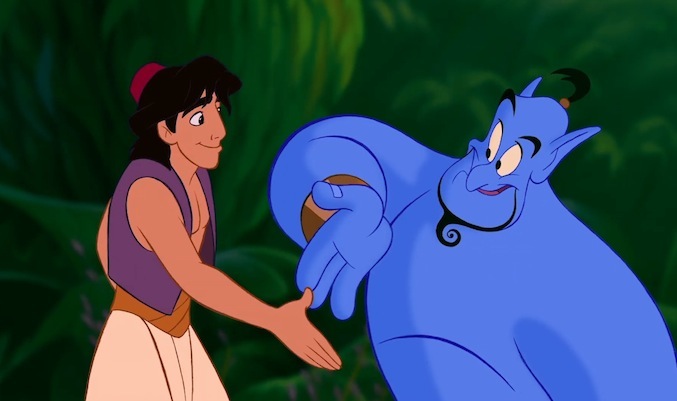
We use the indicative mood most of the time. This verb mood is good for stating facts, making requests, or asking questions. Aladdin uses this mood when he says, “Genie, I wish for you to make me a prince.” The verb in this sentence is wish. This is a simple request, and Genie is happy to lend a hand:

Disney's Aladdin and Genie shaking hands

You’ve got a deal!

Imperative Mood

We use the imperative mood for commands. Our story’s villain, Jafar, is fond of using the imperative mood. After he steals the lamp, he commands: “Genie, grant me my first wish.” Here, the verb is grant. Jafar could have said, “I would like you to grant me my first wish,” which would have been more polite (and indicative). But no. And guess what happens when you use the imperative mood on a genie?

Genie cheering for Jafar in Aladdin

Can you tell I’m motivated?

Subjunctive Mood

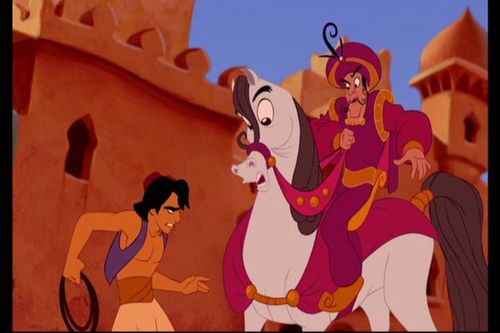
This final verb mood is the trickiest. We use the subjunctive mood for unlikely possibilities, things that are not true, and (you guessed it) wishes. You often find the subjunctive mood hanging around with the word if. Aladdin uses the subjunctive when he protects children from being whipped by a rude prince. He says, “Hey, if I were as rich as you, I could afford some manners!”

We can tell this is the subjunctive mood because Aladdin says I were. This can sound strange to our ears, because normally people say I was. With the subjunctive, however, the verb form were is always used (if I were, if you were, if he were, if she were…).

So why is this verb mood important? It tells us that Aladdin thinks he will never be rich. After all, he doesn’t have a genie to help him with that…yet.

Disney's Aladdin on manners of the rich

If only I had a genie…

Once Aladdin finds Genie, he never uses the subjunctive mood again. Why? Because he knows that his wishes will come true. They are no longer unlikely to happen. So, unlike the rest of us, he doesn’t need to think about when to use the subjunctive mood.

After talking about this, now I really want a genie. I’m sure it would improve my mood. Imagine the possibilities…

When universes collide

Have you ever suffered through a one-sided conversation? Maybe you have nothing in common with the other person, and you find the topic dead boring. Or maybe your conversation partner is an “expert” on everything, and is lecturing you about what you should do. This is sheer torture, you think. When can I make my escape?

Consider yourself lucky. You could be listening to Vogon poetry.

The Hitchhiker’s Guide to the Galaxy tells us that Vogon poetry is the third worst in the universe. (Earth poetry is the worst, of course.) The Vogons know how much everyone hates their poems, but they force people to listen to them out of “sheer bloodymindedness.” Just witness what happens at a friendly Vogon poetry reading:

The sweat stood out cold on Ford Prefect’s brow, and slid round the electrodes attached to his temples. These were attached to a battery of electronic equipment—imagery intensifiers, rhythmic modulators, alliterative residulators and simile dumpers—all designed to heighten his experience of the poem and make sure that not a nuance of the poet’s thought was lost.

– Douglas Adams, The Hitchhiker’s Guide to the Galaxy

Let’s face it, we all have an inner Vogon. We can get so caught up in what we think is important that we ignore what everyone else thinks. We keep on talking or writing, hoping that the sheer volume of our words will convince others of our rightness.

If you truly want to get your message across, remember that you are not the centre of the universe.  Everyone sees things from a unique point of view. You need to connect with others, not collide with them. Here’s some ways you can do this:

  • Address the “So what?” factor. This is also known as WIIFM or “What’s in it for me?” Why should people care about what you have to say? How will it benefit them? You may think the inner workings of the Infinite Improbability Drive are fascinating, but that doesn’t mean they will. Focus on the “So what?” and your message will be more successful.
  • Show some respect. Respect your conversation partner’s time by keeping your message short. Respect that person’s intellect by listening to what he or she has to say. In any conversation, try to spend more time listening than talking. You’ll be amazed at what you discover.
  • Speak in their language. Don’t use uncommon words or jargon that a lot of people don’t know. Your audience shouldn’t need a Babel fish to understand what you are saying.  If you need to use an unusual term to get your message across, then smoothly define it and move on.

And if you find yourself stuck listening to that annoying person? Just remember what The Hitchhiker’s Guide tells us in “large friendly letters” on the cover:

Picture by Jim Linwood. Source: Wikimedia Commons.CC-BY-2.0

Picture by Jim Linwood. Source: Wikimedia Commons.CC-BY-2.0

It will be over soon. Then you can go back to enjoying your universe.